If you want cleaner integration between your mids, highs, and subwoofer, the right crossover can make a dramatic difference. Three-way electronic car audio crossovers help split frequencies more precisely so each speaker plays what it handles best.
Below, we focus on options that make tuning easier, improve output control, and fit different system builds—from simple upgrades to more advanced active setups.
Best 10 Three Way Electronic Car Audio Crossovers Picks for 2026
Flexible RCA Processor Pick
PRV Audio EX4.6 PRO 4/3-Way RCA Processor
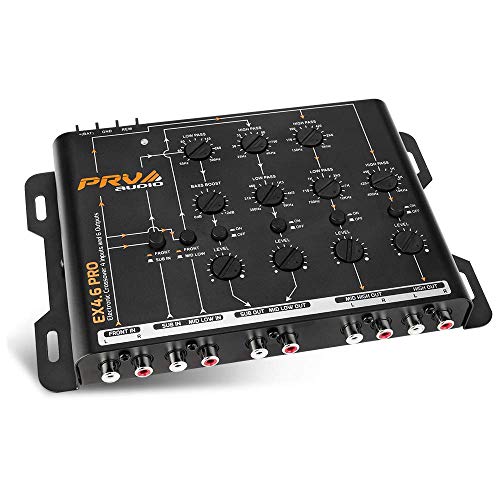
- 2/3/4 RCA input options
- 9V RMS maximum output
- 0 to 12 dB bass boost at 45 Hz
Best For: Active car audio systems that need flexible RCA routing and easy channel control
Custom-Tuning Active Crossover
Audiopipe XV-3-V15BP 3-Way Active Crossover

- Separate front, rear, and sub inputs
- Multiplier switch for continuous frequency adjustment
- Remote bass knob for sub level control
Best For: Custom car audio installs needing detailed 3-way control
Simple 6-Channel Choice
Skar Audio SKEC23 3-Way 6-Channel Crossover

- 3 RCA inputs and 3 RCA outputs
- 10Hz to 30kHz frequency response
- 5V max output with 2-year warranty
Best For: Drivers wanting a straightforward 3-way RCA crossover with 6-channel routing
Speaker-Network Crossover Option
PRV Audio 3DF400/1800 3-Way Speaker Crossover

- Crossover point at 400/1,800 Hz
- Woofer impedance selection for 4 or 8 ohms
- Attenuation and brightness adjustments
Best For: Multi-driver speaker systems needing crossover and level-matching control
Most Flexible 3-Way Pick
Timpano TPT-360 Full-Feature 3-Way Crossover

- Full-feature three-way crossover
- Works in 2-way or 3-way systems
- Wide range of crossover points
Best For: Custom installs that need flexible frequency control
Best Compact Active Option
Hifonics HFXR Active Crossover with Remote Bass Control
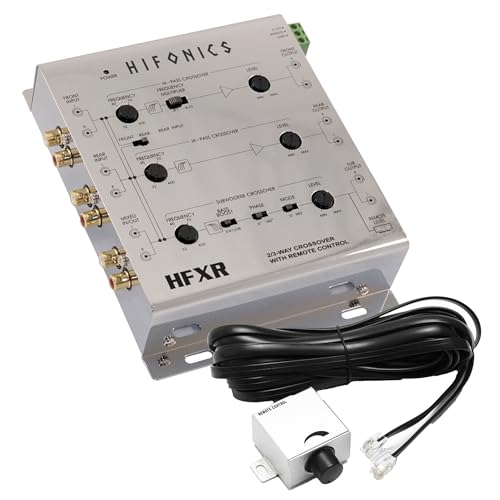
- 2-way/3-way active crossover support
- Remote bass control included
- Compact rack-mountable design
Best For: Compact systems that need active filtering and bass control
Most Adjustable Channel Control
Clarion MCD360V 3-Way RCA Crossover

- 6/4/2-channel RCA input support
- Adjustable front, rear, and sub outputs
- Remote subwoofer level control
Best For: Custom builds needing extensive channel and bass tuning
Budget-Friendly 3-Way Control

- Hi-pass and low-pass crossover sections
- Remote subwoofer level control included
- 12dB per octave slope and switchable input options
Best For: Drivers who want straightforward multi-channel crossover control with remote bass adjustment.
High-Output Active Tuning

- Independent front, rear, and subwoofer tuning
- Built-in 11V line driver for stronger output
- Remote sub control with clip indicator
Best For: Active systems that need stronger pre-output, flexible tuning, and fast bass adjustment.
Full-Feature System Builder
Banda 3-Way Electronic Car Crossover

- Supports two-way or full three-way setups
- 2/4/6 channel inputs with 5V RCA outputs
- Rear fader control and wired sub level remote
Best For: Installers who want broad input/output options and full control over a multi-amp system.
Flexible RCA Processor Pick – PRV Audio EX4.6 PRO 4/3-Way RCA Processor
If you need three way electronic car audio crossovers with flexible system tuning, the PRV Audio EX4.6 PRO is built for active setups that use RCA signal routing. It supports 2/3/4 RCA input options, offers 9 volts RMS maximum output, and includes a 0 to 12 dB bass boost centered at 45 Hz.
Best For: Active car audio builds that need flexible RCA inputs and simple channel control.
Pros:
- 2/3/4 RCA input signal options for different system layouts
- 9 volts RMS maximum output for strong signal handling
- Bass boost adjustable from 0 to 12 dB at 45 Hz
- Quick on/off button for each channel
Cons:
- Uses RCA connections only, so it is aimed at processor-based installs
- Butterworth 12 dB/octave slope may be less flexible than higher-end tuning options
The EX4.6 PRO is a practical choice if you want an active crossover/processor with straightforward controls and enough input flexibility for many car audio layouts. Its channel switching and bass boost make it easy to fine-tune without overcomplicating the install.
Custom-Tuning Active Crossover – Audiopipe XV-3-V15BP 3-Way Active Crossover
For buyers comparing three way electronic car audio crossovers, the Audiopipe XV-3-V15BP stands out for its tuning features and dedicated front, rear, and subwoofer routing. It includes a multiplier switch for continuously adjusting crossover frequency, front and rear high pass outputs, a non-fade low pass output, and a remote bass knob for sub level control.
Best For: Custom installs that need independent front, rear, and subwoofer adjustment.
Pros:
- Separate inputs for front, rear, and subwoofer
- Multiplier switch allows continuous crossover frequency adjustment
- Remote bass knob lets you control subwoofer level from the dash
- Ground loop isolation input circuit and power LED indicator
Cons:
- More tuning features may take longer to set up
- Designed for custom installation rather than plug-and-play use
This model is a strong fit if you want more hands-on control over a 3-way system. Its separate outputs and bass controls make it especially useful when front stage balance and subwoofer management both matter.
Simple 6-Channel Choice – Skar Audio SKEC23 3-Way 6-Channel Crossover
The Skar Audio SKEC23 is a straightforward option in three way electronic car audio crossovers when you want a simple 6-channel layout for front, rear, and subwoofer integration. It offers 3 RCA inputs and 3 RCA outputs, operates at 14.4 volts DC, and is rated for up to 5V output with a wide 10Hz to 30kHz frequency response.
Best For: Systems that need a simple 3-way RCA crossover with standard 6-channel routing.
Pros:
- 3 RCA inputs and 3 RCA outputs for front, rear, and subwoofer
- Wide 10Hz to 30kHz frequency response
- 5V maximum output level
- Backed by a 2-year manufacturer warranty
Cons:
- Fewer tuning details are listed than on some competing processors
- Basic layout may not suit users wanting advanced adjustment features
If you want a clean, uncomplicated active crossover for a 3-way setup, the SKEC23 keeps the signal path easy to manage. Its 6-channel design makes it a practical match for front/rear/subwoofer systems without adding unnecessary complexity.
Speaker-Network Crossover Option – PRV Audio 3DF400/1800 3-Way Speaker Crossover
The PRV Audio 3DF400/1800 is a three-way crossover built for speaker network use, not a typical RCA car processor, but it can still be relevant if your project calls for a rugged passive-style crossover point around 400/1,800 Hz. It includes woofer impedance selection for 4 or 8 ohm setups, selectable woofer roll-off, speaker attenuation, and brightness adjustment for better driver matching.
Best For: Multi-driver speaker systems that need flexible crossover point and attenuation control.
Pros:
- Crossover point at 400/1,800 Hz
- Woofer impedance selection supports 4 or 8 ohm speakers
- Selectable woofer roll-off at 6 dB or 12 dB per octave
- Speaker attenuation and brightness adjustment help match drivers
Cons:
- Not a typical active RCA car audio processor
- Best suited to speaker network applications rather than standard head-unit installs
For builders who need control over driver matching and crossover behavior, this unit offers more speaker-network flexibility than many simple car audio crossovers. It is a specialty solution, but the adjustment options are useful when tuning a multi-driver system.
Most Flexible 3-Way Pick – Timpano TPT-360 Full-Feature 3-Way Crossover
If you want three way electronic car audio crossovers with enough flexibility for custom tuning, the Timpano TPT-360 is built to handle both 2-way and full 3-way setups. It gives you a wide range of crossover points between the front, rear, and subwoofer outputs, making it a practical choice when you want clearer frequency separation and a more organized system layout.
Best For: Builders who want a full-feature crossover that can also work in simpler 2-way systems.
Pros:
- Full-feature three-way crossover with 2-way compatibility
- Wide range of crossover points for front, rear, and sub outputs
- Designed for clearer frequency distribution across a custom system
- Includes front/rear fade capability in 2-way use
Cons:
- No remote subwoofer control mentioned in the notes
- May be more crossover than a basic system needs
The TPT-360 focuses on tuning flexibility rather than extras, which makes it a solid fit if you are building around clean signal management. Its strength is in giving you control over how each section of the system is divided, so it suits users who want a straightforward but capable electronic crossover.
Best Compact Active Option – Hifonics HFXR Active Crossover with Remote Bass Control
Hifonics HFXR 2-Way/3-Way Active Crossover, Car Audio Crossover with Remote Bass Control
Check Price On AmazonThe Hifonics HFXR is a practical option if you are comparing three way electronic car audio crossovers and want active filtering plus remote bass control. It supports 2-way/3-way use, offers 2/4 channel input selection, and includes high-pass and low-pass filters for front, rear, and subwoofer channels. Its compact rack-mountable size also makes it easier to fit into a tighter audio setup.
Best For: Drivers who want active crossover control and easy bass adjustment in a compact unit.
Pros:
- Supports 2-way/3-way active crossover use
- Remote control for bass adjustment
- Includes high-pass and low-pass filters for multiple channels
- Compact, rack-mountable design
Cons:
- Fewer detailed tuning specs are listed than some rivals
- Best suited to users who want active control, not ultra-minimal setup
For buyers who want a crossover that does more than basic signal splitting, the HFXR adds useful bass shaping and input flexibility. It is a good fit if remote bass control matters and you want an active unit that can adapt to different car audio layouts.
Most Adjustable Channel Control – Clarion MCD360V 3-Way RCA Crossover
The Clarion MCD360V is a strong fit for shoppers looking at three way electronic car audio crossovers and wanting a more detailed control set. It supports 2-, 3-, and 6-channel RCA inputs, includes adjustable output levels for front, rear, and subwoofer, and adds a remote subwoofer level control plus bass boost. The ground loop isolation circuit and gold-plated RCA and power connections round out a very complete package.
Best For: Users who want extensive tuning control and multiple RCA input/output options.
Pros:
- Supports 6/4/2-channel RCA inputs
- Adjustable level output for front, rear, and subwoofer
- Remote subwoofer level control and bass boost
- Ground loop isolation circuit and gold-plated connections
Cons:
- More complex than a basic crossover
- Larger and heavier than the most compact options
If you want a crossover with broad adjustment capability, the MCD360V stands out for its blend of routing flexibility and tuning features. It is aimed at custom car audio builds where fine control over channel balance and subwoofer output is more important than keeping things simple.
Budget-Friendly 3-Way Control – LANZAR Vibe VIBEX6
If you want three way electronic car audio crossovers with broad control at a lower-cost entry point, the LANZAR Vibe VIBEX6 focuses on core tuning features for front, rear, and subwoofer channels. It offers hi-pass and low-pass filtering, a remote subwoofer level control, and a 12dB octave slope, making it a practical choice for basic active system setup.
Best For: Drivers who want straightforward multi-channel crossover control with remote bass adjustment.
Pros:
- Hi-pass and low-pass crossover sections for front/rear and subwoofer tuning
- Remote subwoofer level control included for easy bass adjustment
- 12dB per octave slope for system integration
- Parallel input switch and mixed in/out switch add flexibility
Cons:
- Front/rear hi-pass range is listed with an unusually wide frequency response in the supplied notes
- Bulkier than some compact active processors
- Features are functional, but not as advanced as some higher-end units
Overall, the VIBEX6 is a straightforward three-way crossover built around essential controls rather than premium extras. It should suit users who need basic signal splitting, sub level control, and simple adjustment options in one unit.
High-Output Active Tuning – DS18 XM3 3-Way Crossover
The DS18 XM3 is aimed at users shopping for three way electronic car audio crossovers with more signal-shaping flexibility and stronger output. It combines independent front, rear, and subwoofer tuning with a built-in 11V line driver, adjustable bass boost, and a remote subwoofer controller with clip indication for quick on-the-fly changes.
Best For: Active systems that need stronger pre-output, flexible tuning, and fast bass adjustment.
Pros:
- Independent front, rear, and subwoofer control for 3-way systems
- Built-in 11V line driver for higher-voltage pre-output
- Remote subwoofer controller includes clip indicator
- Adjustable filters and Tiffany RCA connectors for a more polished install
Cons:
- Requires 9–15V operation, so it is more specialized than a passive-style solution
- More complex than basic crossover-only units
- Best suited to users comfortable with active system setup
In practice, the XM3 stands out when the goal is cleaner signal handling and more precise active tuning. Its line-driver output and onboard bass control make it a strong fit for systems where signal strength and fast adjustment matter.
Full-Feature System Builder – Banda 3-Way Electronic Car Crossover
For shoppers comparing three way electronic car audio crossovers that can manage more complex installs, the Banda unit is built for two-way or full three-way system layouts. It supports 2/4/6 channel inputs, 5V RCA outputs, rear fader control, subwoofer equalization, and a wired remote subwoofer level control, giving you a lot of system-shaping tools in one processor.
Best For: Installers who want broad input/output options and full control over a multi-amp system.
Pros:
- Works with two-way or three-way system set-ups
- 2/4/6 channel RCA inputs and 6 channel 5V RCA outputs
- Rear fader control plus adjustable front, rear, and sub levels
- Ground loop isolation, phase reversal switch, and gold-plated connections
Cons:
- More feature-rich than a simple crossover, so setup may take longer
- Bigger footprint than compact processors
- Best value comes when you need its full routing and control options
The Banda crossover is the most flexible of the group for users building a multi-amplifier system. If you want broad routing options, remote bass control, and adjustment tools for front/rear/sub balancing, this is the most comprehensive pick here.
How We Picked the Best Three Way Electronic Car Audio Crossovers
We focused on models that offer practical tuning control, reliable channel flexibility, and features that matter in real installs. That includes adjustable crossover points, subwoofer level control, bandpass or high/low-pass options, and enough inputs or outputs to support common front-rear-sub configurations.
We also weighed ease of installation, signal clarity, and how well each unit suits a range of systems, from entry-level active setups to more demanding SQ or SPL-oriented builds.
Quick Comparison
In general, look for a unit with the right number of channels and controls for your system size. Some Three Way Electronic Car Audio Crossovers are built for simple front/rear/sub tuning, while others add line-driver output, bass boost, remote sub control, or expanded input/output routing for more advanced processors.
Best for Simple Active Systems
If you want straightforward tuning with minimal complexity, choose a crossover with clearly labeled controls and standard 3-way filters.
Best for More Advanced Systems
If your build uses multiple amplifiers or needs stronger output, prioritize higher-voltage line drive, wider adjustment ranges, and flexible channel routing.
Key Buying Factors for Three Way Electronic Car Audio Crossovers
Crossover ranges: Make sure the low-pass, band-pass, and high-pass points fit your speakers and subwoofer. A good range helps reduce distortion and protects drivers.
Channel count and inputs: Check whether you need 2, 4, or 6 channel inputs and outputs. This matters for OEM integration, front/rear fading, and multi-amp systems.
Control features: Remote subwoofer level control, bass boost, rear fader support, and output level adjustment can make tuning much easier after installation.
Signal strength: Higher output voltage or a built-in line driver can improve noise performance and help drive amplifiers more effectively.
Install fit: Compact sizing, clear labeling, and accessible adjustment knobs are important if the crossover will be mounted under a seat or behind a panel.
Who Should Buy Which Three Way Electronic Car Audio Crossovers?
Choose a flexible 3-way crossover if you are building a full active front stage with separate tweeters, mids, and sub control.
Choose a crossover with remote bass control if you want easy day-to-day adjustment without reopening the dash or trunk.
Choose a line-driver-equipped model if you need stronger output and cleaner signal delivery for larger amplifier setups.
Choose a compact, basic unit if you mainly want better frequency separation and simpler tuning on a budget.
For most buyers, the best choice is the model that matches your speaker layout first, then offers enough adjustment to fine-tune the system without adding unnecessary complexity.