
Building a serious active car audio system starts with the right crossover. The best units help you split frequencies precisely, protect your speakers, and tune each driver for a cleaner, more balanced sound.
Below, we highlight the best digital crossovers for active car audio in 2026, focusing on the features buyers actually need: input/output flexibility, voltage handling, bass control, and easy system integration.
Best 10 Digital Crossovers for Active Car Audio Picks for 2026
Flexible RCA Crossover
PRV Audio EX4.6 PRO 4-Way/3-Way Crossover
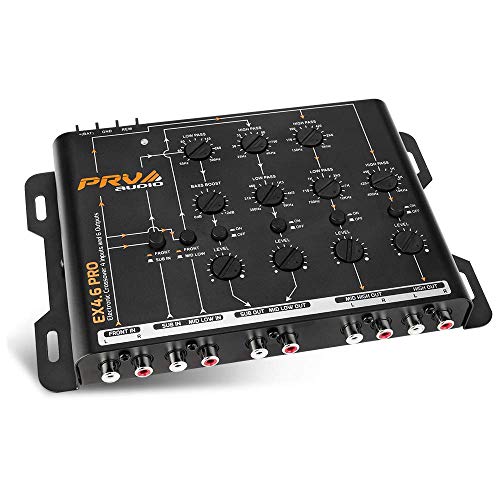
- 2/3/4 RCA input options
- 4 in / 6 out RCA routing
- Bass boost up to 12 dB at 45 Hz
Best For: Active systems needing simple crossover control and flexible RCA hookups
Remote Bass Control Crossover
Hifonics HFXR 2-Way/3-Way Active Crossover
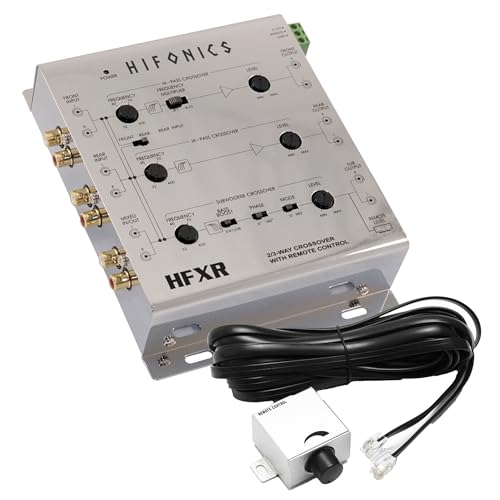
- 2-way or 3-way active crossover modes
- Remote bass control with 45 Hz boost
- 2/4 channel input selection
Best For: Users who want bass control and flexible channel filtering
Full DSP Upgrade
Taramps Pro 2.4D Digital DSP Crossover

- Full digital signal processor with crossover tools
- RCA and high-level input support
- Peak/RMS limiter plus 5-band EQ
Best For: Tuners wanting advanced DSP control and protection features
Compact Active Processor
Autotek ATK2 3X 2/3-Way Active Crossover

- 2-way and 3-way active crossover support
- Remote bass control included
- 180-degree phase shift switch
Best For: Installers wanting a compact processor with basic tuning controls
Simple 3-Way Splitter
Skar Audio SKEC23 3-Way 6-Channel Crossover

- 3-way electronic crossover with 6 RCA channels
- 10Hz to 30kHz frequency response
- 5V max output and 2-year warranty
Best For: simple active systems needing front, rear, and subwoofer routing
Bass Recovery Processor
Audiobank AP15 Bass Processor with Remote

- Bass maximizer and sound restoration features
- Dash-mount remote plus subsonic filter
- 15V RMS input and 13.5V peak output
Best For: subwoofer-focused systems needing bass restoration and level control
Flexible Active Crossover
PRV Audio EX3.5 Stereo 2/3-Way Crossover
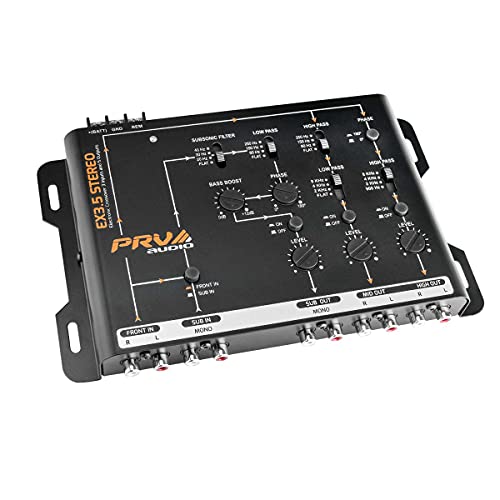
- 2-way or 3-way crossover with 6 RCA outputs
- Adjustable HPF, LPF, and bass boost controls
- Butterworth 12 dB/Octave slope with per-channel on/off
Best For: builders who want flexible tuning and channel-specific control
Bass Restoration Processor
Audiotek AT-AP100 Bass Processor

- Bass maximizer and restoration processor
- Dash mount remote bass knob included
- 15V RMS input, 13.5V peak output
Best For: Drivers who want easy subwoofer tuning and bass restoration
Compact 4-Way Crossover

- 4-channel RCA crossover design
- Compact 190 x 145 x 40 mm size
- Bass boost and customizable adjustments
Best For: Compact car audio systems needing adjustable crossover control
Pro Level Signal Processor
Recoil CRX-PRO 5-Way Crossover

- 5-way frequency splitting from 30 Hz to 20 kHz
- Subsonic filter, bass boost, and phase inverter
- 0.01% THD with 85 dB crosstalk rejection
Best For: Advanced active car audio builds needing precise band splitting
Flexible RCA Crossover – PRV Audio EX4.6 PRO 4-Way/3-Way Crossover
For shoppers comparing digital crossovers for active car audio, the PRV Audio EX4.6 PRO is a straightforward analog-style electronic crossover that focuses on routing flexibility and output control. It supports 2/3/4 RCA input signal options, gives you 4 RCA in and 6 out, and includes a 9-volt RMS maximum output with a Butterworth 12 dB/octave slope.
Best For: Active car audio builds that need flexible RCA routing and simple channel control.
Pros:
- Supports 2/3/4 RCA input signal options for different system layouts
- Offers 4 RCA inputs and 6 RCA outputs for flexible routing
- Includes quick on/off control for each channel
- Bass boost can be set from 0 to 12 dB at 45 Hz
Cons:
- Maximum output is limited to 9 volts RMS
- Uses a Butterworth 12 dB/octave slope only
- Does not include digital DSP-style tuning features
Overall, the EX4.6 PRO is a practical choice if you want an electronic crossover with simple controls, multiple input options, and dedicated bass boost without stepping into a more complex processor.
Remote Bass Control Crossover – Hifonics HFXR 2-Way/3-Way Active Crossover
If you’re evaluating digital crossovers for active car audio, the Hifonics HFXR is built around flexible 2-way or 3-way operation, plus front/rear/subwoofer filtering. It offers 2/4 channel input selection, mono/stereo control, and a remote bass control feature with a 45 Hz boost and quasi-parametric equalizer.
Best For: Car audio setups that need active crossover control with remote bass adjustment.
Pros:
- Works as a 2-way or 3-way active crossover
- Offers flexible 2/4 channel input selection
- Includes remote bass control for easy adjustment
- Features high-pass and low-pass filters plus 45 Hz boost
Cons:
- Uses a rack-mountable tabletop-style design rather than an in-dash format
- Listed output and feature set are centered on analog crossover functions
- Dimension profile is larger than some compact processors
The HFXR makes sense if you want a dedicated active crossover with bass tuning tools and straightforward filtering for front, rear, and subwoofer channels.
Full DSP Upgrade – Taramps Pro 2.4D Digital DSP Crossover
For buyers looking at digital crossovers for active car audio, the Taramps Pro 2.4D stands out as a full digital signal processor with crossover control, EQ, and limiter tools. It supports RCA and high-level input, includes 4-channel output, and adds peak and RMS limiter functions along with an anti-pop system for cleaner system startup and shutdown.
Best For: System tuners who want a more advanced DSP with crossover, EQ, and limiter controls.
Pros:
- Full digital signal processor with crossover adjustments
- RCA and high-level inputs for broader compatibility
- Peak and RMS limiter functions help reduce distortion risk
- Includes 5-band input EQ, 12 presets, and parametric output EQ
Cons:
- More complex than a basic electronic crossover
- Requires tuning to take full advantage of its feature set
- Lower weight and compact size may still demand careful mounting
The Pro 2.4D is the most feature-rich option here, making it a strong fit when you want detailed control over crossover behavior, equalization, and output protection.
Compact Active Processor – Autotek ATK2 3X 2/3-Way Active Crossover
In a roundup of digital crossovers for active car audio, the Autotek ATK2 3X is a compact active crossover processor focused on 2-way and 3-way system tuning. It runs at 8.5 volts, includes remote bass control, built-in crossovers, level adjust, and a 180-degree phase shift switch for subwoofer output alignment.
Best For: Car audio systems that need a simple active processor with bass and phase adjustment.
Pros:
- Supports both 2-way and 3-way operation
- Includes remote bass control for convenient tuning
- Built-in crossovers and level adjust simplify setup
- 180-degree phase shift helps align subwoofer output
Cons:
- Limited to 8.5-volt operation
- Feature set is more basic than a full DSP processor
- Surface-mount design may not suit every install
The ATK2 3X is a sensible pick if you want active crossover control with a few practical tuning tools, without moving into a more elaborate digital processor.
Simple 3-Way Splitter – Skar Audio SKEC23 3-Way 6-Channel Crossover
If you’re comparing digital crossovers for active car audio, the Skar Audio SKEC23 is a straightforward 3-way electronic option built for front, rear, and subwoofer routing. It offers 3 RCA inputs and 3 RCA outputs, a 10Hz to 30kHz frequency response, and up to 5V max output, making it a practical pick for a basic active-system layout.
Best For: Drivers building a simple active setup with dedicated front, rear, and subwoofer signal paths.
Pros:
- 3-way electronic crossover with 6-channel RCA layout.
- Wide 10Hz to 30kHz frequency response for full-range system use.
- 5V max output and 20K ohm input impedance for standard car audio integration.
- Compact chassis with a 2-year manufacturer warranty.
Cons:
- Requires a 14.4V DC operating setup.
- Less feature-heavy than processors with remote tuning or extra bass controls.
This is a solid no-frills crossover if you want a dedicated active signal split without extra complexity. Its value is in clean 3-way routing and simple system matching.
Bass Recovery Processor – Audiobank AP15 Bass Processor with Remote
For shoppers focused on digital crossovers for active car audio, the Audiobank AP15 is aimed more at subwoofer tuning and bass recovery than full-system management. It includes bass maximization, sound restoration, a subsonic filter, and a dash-mount remote, so it fits well when the priority is tightening low-end output in a car audio system.
Best For: Systems that need bass restoration and remote subwoofer level control.
Pros:
- Bass maximizer and bass restoration processor for low-frequency recovery.
- Includes a dash-mount remote control for quick adjustment.
- Subsonic filter and bass level control help manage sub output.
- 13.5V peak output and 15V RMS input support car audio use.
Cons:
- Designed around subwoofer processing, not full 3-way crossover routing.
- Listed as a 1.0-channel device, so it is not a multi-channel crossover solution.
If your build needs more bass shaping than crossover flexibility, this unit is a focused tool. It is best treated as a subwoofer processor for adding control and restoring low-end detail.
Flexible Active Crossover – PRV Audio EX3.5 Stereo 2/3-Way Crossover
The PRV AUDIO EX3.5 Stereo is a more flexible choice among digital crossovers for active car audio, with support for 2-way or 3-way setups and up to 6 RCA outputs. It also adds adjustable high-pass and low-pass filters, output level control on each channel, and bass boost on the sub out channel, which makes it well suited for users who want more tuning control.
Best For: Active car audio builds that need adjustable crossover points and per-channel output control.
Pros:
- Works as a 2-way or 3-way electronic crossover.
- 2/4 RCA inputs and 6 RCA outputs support flexible system layouts.
- Adjustable high-pass, low-pass, and bass boost controls add tuning range.
- Quick on/off buttons for each channel and Butterworth 12 dB/Octave slope.
Cons:
- Requires 10V to 12V DC supply, so power compatibility matters.
- More settings mean more setup effort than a basic crossover.
This model stands out if you want an active crossover with real tuning flexibility rather than a fixed layout. It is a strong fit for systems where channel control and filter adjustment are part of the build plan.
Bass Restoration Processor – Audiotek AT-AP100 Bass Processor
If you’re shopping for digital crossovers for active car audio and want more control over low-end playback, the Audiotek AT-AP100 is built around bass restoration and subwoofer tuning. It offers a simple, dash-mounted setup with a lighted display and remote bass knob, making it a practical pick for systems that need stronger bass shaping without a complicated install.
Best For: Drivers who want an easy-to-use bass processor and subwoofer tuning control.
Pros:
- Bass maximizer and bass restoration processing for low-end enhancement
- Includes a dash mount remote control for quick adjustment
- Wide 10 Hz to 100,000 Hz frequency response
- Supports up to 15V RMS input and 13.5V peak output
Cons:
- Single-channel design limits flexibility for full-system crossover duties
- Focuses on bass control rather than broader multi-way processing
- May be more specialized than buyers wanting a full active crossover network
This is best viewed as a dedicated bass solution rather than a full-featured processor. If your priority is restoring and adjusting subwoofer output with a straightforward control layout, the AT-AP100 fits that role well.
Compact 4-Way Crossover – Taramps CRX4 RCA Processor
For shoppers comparing digital crossovers for active car audio, the Taramps CRX4 offers a compact RCA-based layout with adjustable sound shaping. Its 4-channel design and bass boost features make it a practical fit when you want flexible low/high tuning in a small processor.
Best For: Compact systems that need adjustable crossover control and bass shaping.
Pros:
- Compact footprint at 190 x 145 x 40 mm
- 4-channel crossover with customizable sound adjustments
- RCA connectivity for car audio system integration
- Includes bass boost for added low-end tuning
Cons:
- More limited channel count than larger multi-way processors
- Feature set is geared toward adjustment rather than advanced processing
- May suit smaller installs better than complex active setups
The CRX4 stands out if space is tight and you still want usable crossover control. It looks like a solid middle-ground option for systems that need tuning flexibility without a bulky processor.
Pro Level Signal Processor – Recoil CRX-PRO 5-Way Crossover
If you need digital crossovers for active car audio with more precise signal splitting, the Recoil CRX-PRO is built for a full multi-way setup. It divides audio into 5 optimized bands and adds subsonic filtering, phase inversion, and bass boost, which makes it suited to more serious system tuning.
Best For: Enthusiasts building a more advanced active car audio system.
Pros:
- 5-way frequency splitting with adjustable crossover points from 30 Hz to 20 kHz
- Subsonic filter, bass boost, and 0°/180° phase inversion
- 4-channel output with pass-thru and flexible input selection
- Low 0.01% THD and 85 dB crosstalk rejection
Cons:
- More complex than simpler bass-focused processors
- May be more crossover than basic subwoofer-only systems need
- Install may still require careful setup to use its full feature set
This is the most capable option in the group for structured active system tuning. If you want detailed band splitting and more control over the signal path, the CRX-PRO is the strongest fit here.
How We Picked These Digital Crossovers for Active Car Audio
We focused on processors that fit real-world active setups, not just spec sheets. Important factors included channel count, 2-way, 3-way, or higher-order support, input compatibility, output voltage, bass management, and whether the unit is suited to simple factory-upgrade systems or more advanced builds.
We also favored models with practical tuning tools such as remote bass control, high-level input support, and built-in EQ or sound restoration features when they add value without making setup overly complicated.
Quick Comparison
If you want the simplest path, a 2-way or 3-way crossover is usually enough for front-stage active builds. If you are running more drivers, multiple amplifiers, or want broader signal control, a 4-way or multi-output processor gives you more flexibility.
For factory systems or bass-focused upgrades, models with high-level input and bass restoration can make integration easier. For custom systems, prioritize clean RCA routing, solid output voltage, and enough channels to match your amplifier plan.
Key Buying Factors for Digital Crossovers for Active Car Audio
Channel Count and Crossover Flexibility
Choose a crossover that matches your system design. A 2-way or 3-way unit is ideal for many active front stages, while larger systems may benefit from 4-way or 5-way processing. More channels can mean more routing options, but only if you actually need them.
Input Type and System Integration
Look at whether the unit accepts RCA inputs, high-level speaker inputs, or both. High-level compatibility is especially useful when adding Digital Crossovers for Active Car Audio to factory head units without replacing the entire source system.
Output Voltage and Signal Cleanliness
Higher output voltage can improve signal transfer to amplifiers and help reduce noise in some setups. That said, matching gain structure properly matters more than chasing the highest number on the box.
Bass Control and Subwoofer Management
If you run a subwoofer, remote bass control, bass boost, or low-frequency shaping can make tuning easier from the driver seat. Subsonic filtering and precise low-end control are especially valuable in vented box systems.
EQ and DSP Features
Some models include digital signal processing, sound restoration, or equalization. These extras can be useful, but only if you want more tuning control and are comfortable spending time dialing in the system.
Who Should Buy Which Digital Crossovers for Active Car Audio?
If you want a straightforward active front stage, pick a 2-way or 3-way crossover with clean RCA outputs and simple controls. If you are building a larger multi-amp system, choose a higher-channel processor with more routing options.
If your car still uses the factory radio, prioritize high-level input and sound-restoration features. If your main goal is subwoofer tuning, focus on bass control, low-pass management, and reliable signal handling rather than extra processing you may never use.
In short, the best Digital Crossovers for Active Car Audio are the ones that match your system design, source unit, and tuning skill level.