Upgrading a factory sound system with an amplified OEM setup can be tricky, especially when the signal path is already processed before it reaches your speakers. That is where a well-matched DSP helps.
This roundup of the best car DSP processors for OEM amplified systems focuses on models that make integration, tuning, and sound correction easier without forcing a full system rebuild.
Best 10 Car Dsp Processors for Oem Amplified Systems Picks for 2026
Factory Integration DSP
AudioControl DM-810 for OEM amplified systems

- Speaker-level, RCA, S/PDIF, and TOSLINK inputs
- AccuBASS restores bass lost at higher volumes
- PC-based tuning with 30-band EQ and RTA
Best For: Factory amplified systems needing summing and precise tuning
Compact OEM DSP
Hertz H8 compact DSP processor

- High-level and low-level input support
- Multiple outputs for front, rear, sub, and center
- USB PC control with optical and AUX options
Best For: Compact OEM-friendly installs with PC tuning
App-Control DSP
Banda Audiopart X8AiR 8-channel DSP
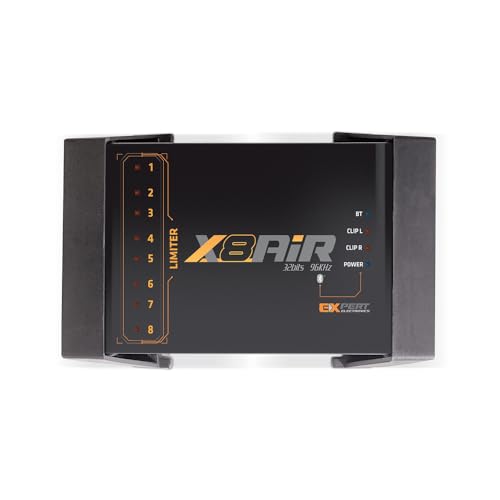
- 32-bit/96kHz DSP with 79-band EQ
- Bluetooth app control for real-time tuning
- 4 inputs and 8 outputs for complex systems
Best For: Smartphone-tuned OEM or aftermarket upgrades
Preset EQ DSP
Taramp's Pro 2.4S preset EQ processor

- 15-band EQ with up to 12 dB adjustment
- 12 preset curves for quick sound shaping
- Selectable crossover filters with multiple slopes
Best For: Simple tuning and crossover control in OEM systems
Bluetooth DSP Compact Tuning
Timpano TPT-SP4BT Bluetooth DSP 4 Output Channel

- Bluetooth app control for Android and iOS
- Real-time EQ, crossover, alignment, and gain tuning
- Built-in voltmeter, test tones, and sequencer
Best For: App-controlled tuning in compact OEM or aftermarket installs
Factory-Input DSP PRO
Stetsom STX 2436 Bluetooth DSP PRO

- RCA and high-level inputs for factory radios
- 12-band graphic EQ with crossover and filters
- Bluetooth app control plus voltmeter and limiter
Best For: OEM factory-radio integration with detailed smartphone tuning
8-Channel Crossover DSP
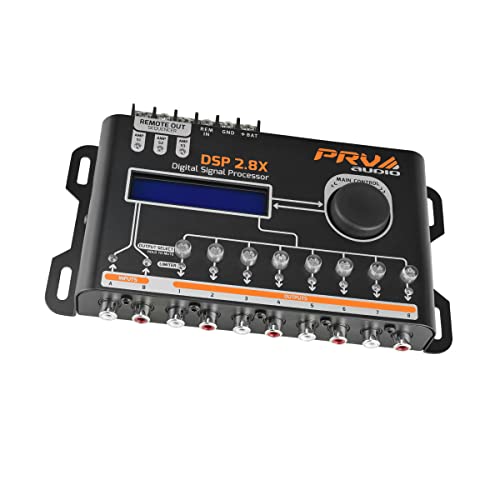
- 8 independent outputs with A/B routing
- 15-band graphic EQ and parametric EQ control
- Sequencer remote relay for turn-on control
Best For: Multi-channel OEM systems needing flexible routing and tuning
Wireless OEM-Friendly DSP
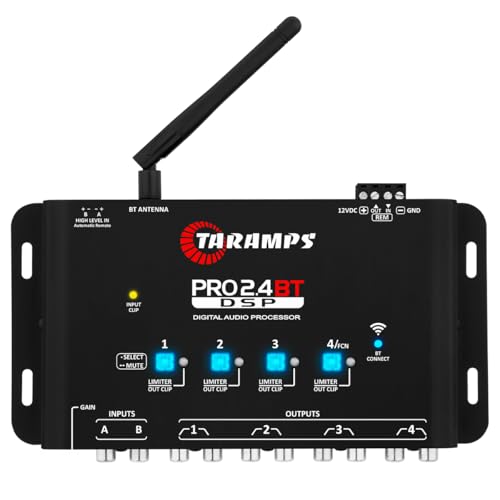
- Bluetooth 5.4 BLE app tuning in real time
- High-level input with auto turn-on for factory head units
- 15-band EQ, crossover, delay, phase, and limiter control
Best For: Factory-system upgrades that need wireless control and easy integration
Hands-On Factory DSP

- LCD interface for real-time audio adjustments
- 2 inputs and 4 outputs with A/B source routing
- 15-band EQ, parametric EQ, and 12 presets
Best For: Installers who want simple onboard control and source switching
High-Output OEM DSP

- 2 inputs and 8 outputs for larger builds
- 15-band EQ, time alignment, and crossover tools
- Integrated audio generator for calibration and testing
Best For: Larger multi-channel OEM upgrades that need extensive tuning
Factory Integration DSP – AudioControl DM-810 for OEM amplified systems
If you need car dsp processors for oem amplified systems, the AudioControl DM-810 is built around flexible factory integration. It accepts speaker-level, RCA, S/PDIF, and TOSLINK inputs, then gives you summed outputs, AccuBASS recovery, and PC-based tuning for a clean OEM-friendly upgrade path.
Best For: Tuning factory amplified systems that need summing, bass restoration, and detailed setup control.
Pros:
- Multiple input options, including speaker-level, RCA, S/PDIF, and TOSLINK
- AccuBASS helps recover bass lost at higher volumes
- 30-band EQ, RTA support, and PC/laptop tuning for precise adjustments
- Includes signal-sense turn-on and MILC clipping indicator
Cons:
- Tuning is PC-based, so it is not a simple set-and-forget unit
- Summing and integration features are best suited to users comfortable with factory audio signal issues
The DM-810 stands out for OEM integration flexibility and its ability to correct factory-system quirks. It is a strong choice if your goal is to keep the original radio while gaining serious DSP control.
Compact OEM DSP – Hertz H8 compact DSP processor
The Hertz H8 DSP Processor is a compact option for car dsp processors for oem amplified systems when you want straightforward high- and low-level integration. It offers speaker and preamp inputs, multiple preamp outputs, USB connection to a computer, and software control for practical system tuning.
Best For: Small-space installs that need OEM and aftermarket input flexibility with computer-based control.
Pros:
- Supports high-level speaker inputs and low-level preamp inputs
- Multiple outputs cover front tweeter, woofer, rear, sub, and center channels
- USB connection and Windows software support tuning from a PC
- Optical/AUX selection and memory A/B control add setup flexibility
Cons:
- Software support is limited to Windows versions listed in the notes
- Less feature-rich than some higher-channel-count processors
This processor is a practical fit if you want OEM integration without a large chassis or overly complex layout. Its compact size and flexible routing make it a sensible foundation for a controlled factory-audio upgrade.
App-Control DSP – Banda Audiopart X8AiR 8-channel DSP
For buyers comparing car dsp processors for oem amplified systems, the Banda Audiopart X8AiR brings app-based control and a dense tuning toolkit. Its 32-bit/96kHz DSP, 79-band EQ, crossover, time alignment, and Bluetooth management are aimed at users who want detailed sound shaping from a factory or aftermarket setup.
Best For: Users who want smartphone control and highly detailed tuning in a multi-channel DSP.
Pros:
- 32-bit/96kHz DSP for precise multi-channel processing
- 79 EQ bands per channel plus crossover, time alignment, phase control, and limiter
- Bluetooth and app control allow real-time adjustments from a phone
- 4 inputs and 8 outputs support complex multi-amplifier systems
Cons:
- Feature set is extensive, so setup may be more involved than simpler processors
- Best suited to users who will actually use app-based tuning features
The X8AiR is a strong pick when you want modern control and advanced tuning in one unit. It is especially appealing if you plan to refine a factory system without giving up flexibility for future upgrades.
Preset EQ DSP – Taramp's Pro 2.4S preset EQ processor
If you want car dsp processors for oem amplified systems with a simpler control approach, the Taramp’s Pro 2.4S focuses on EQ presets and crossover shaping. It combines 15-band graphic EQ, preset sound curves, selectable crossover filters, and output level control for users who want straightforward tuning options.
Best For: Drivers who prefer preset EQ shapes and flexible crossover control over app-based tuning.
Pros:
- 15-band graphic equalization with up to 12 dB adjustment
- 12 preset EQ curves for common listening styles
- Adjustable crossover filters with multiple filter types and slopes
- Output level control allows gain or attenuation on each way
Cons:
- 2-channel in and 4-channel out is less expansive than larger processors
- More focused on core tuning functions than advanced connectivity
The Pro 2.4S is a practical solution if you want clean signal shaping without a complicated interface. Its presets and crossover tools make it a useful fit for controlled system refinement in OEM-based installs.
Bluetooth DSP Compact Tuning – Timpano TPT-SP4BT Bluetooth DSP 4 Output Channel
If you’re looking for car dsp processors for oem amplified systems, the Timpano TPT-SP4BT is a compact option that lets you tune from your phone or tablet instead of digging through hardware controls. It supports factory radio or aftermarket unit setups and includes real-time adjustment tools for EQ, crossover filters, alignment, gain, phase inversion, limiter settings, and input/output routing.
Best For: Drivers who want app-based tuning, remote startup sequencing, and built-in diagnostic tools in a small DSP.
Pros:
- Bluetooth control from Android or iOS devices
- Real-time adjustment of EQ, crossover, alignment, gain, and phase
- Built-in voltmeter plus frequency generator, sweep, and pink noise
- Sequencer feature can trigger up to three products on startup/shutdown
Cons:
- Only 4 output channels, so it may be limiting for larger builds
- Requires phone or tablet app access for configuration
This model stands out if you want a small, wireless DSP that still offers the core tuning tools needed for factory-based systems. Its diagnostic features and sequencer add flexibility, but the channel count is best suited to simpler installs.
Factory-Input DSP PRO – Stetsom STX 2436 Bluetooth DSP PRO
For shoppers comparing car dsp processors for oem amplified systems, the Stetsom STX 2436 focuses on flexible input support and deep sound shaping. It offers Bluetooth control through Android and Apple apps, plus RCA and high-level input compatibility for factory original stereo players, making it a practical fit when you need to integrate with OEM audio gear.
Best For: Factory-radio integrations that need app-based control and detailed EQ/crossover adjustment.
Pros:
- Supports both RCA and high-level inputs for factory systems
- Bluetooth app control on Android and iOS devices
- 12-band graphic EQ with high-precision crossover and filters
- Includes voltmeter and limiter functions
Cons:
- Bluetooth range is listed at up to 49 feet in unobstructed areas
- Requires compatible Android or iOS software version
The STX 2436 is a strong pick when factory-input flexibility matters as much as tuning depth. Its password protection and compact design add convenience, while the EQ and crossover tools give you room to refine an OEM-amplified setup.
8-Channel Crossover DSP – PRV AUDIO Car Audio DSP 2.8X
If you need car dsp processors for oem amplified systems with more output flexibility, the PRV AUDIO DSP 2.8X is built around 8 independent channels and two audio inputs. It lets you choose source routing per output, then fine-tune with a 15-band graphic EQ, parametric EQ control, crossover settings, and preset sound profiles.
Best For: Multi-channel builds that need flexible routing, sequenced turn-on, and detailed crossover control.
Pros:
- 8-channel independent outputs with A/B input selection
- 15-band graphic EQ plus parametric EQ adjustments
- Includes multiple presets for quick sound shaping
- Sequencer remote relay can trigger other products through REM
Cons:
- Interface is LCD-based rather than app-based
- May be more than needed for simple OEM integration
The DSP 2.8X is the most flexible option here for complex routing and output management. If your OEM-amplified system needs more channels and granular tuning, this model gives you plenty of control without relying on a smartphone app.
Wireless OEM-Friendly DSP – Taramps Pro 2.4 BT
If you’re shopping for car dsp processors for oem amplified systems, the Taramps Pro 2.4 BT is built around easy factory integration and real-time tuning. It supports high-level input with auto turn-on for factory head units, RCA inputs up to 9V RMS, and Bluetooth 5.4 BLE app control so you can adjust crossover, EQ, delay, and limiter settings from your phone.
Best For: Daily drivers and OEM integration projects that need wireless tuning and straightforward factory-head-unit compatibility.
Pros:
- Bluetooth app control lets you configure parameters in real time.
- High-level input with auto turn-on is ideal for factory systems.
- 24-bit/48kHz processing, 15-band EQ, and crossover filters offer detailed tuning.
- RCA input up to 9V RMS and anti-puff system help with clean integration.
Cons:
- Only 2 inputs and 4 outputs, so larger systems may need more channels.
- Best suited to users comfortable with DSP setup and app-based tuning.
Overall, this is a practical pick if you want a compact DSP that can slot into an OEM amplified setup without giving up serious tuning control. Its wireless interface and factory-friendly inputs make it especially appealing for installations where convenience matters as much as sound shaping.
Hands-On Factory DSP – PRV DSP 2.4X
For shoppers comparing car dsp processors for oem amplified systems, the PRV AUDIO DSP 2.4X stands out for its straightforward LCD-based control and flexible source routing. It offers 2 audio inputs, 4 independent outputs, source selection for A, B, or A+B on each output, plus a 15-band graphic EQ and parametric equalizer tools for practical tuning.
Best For: Users who want hands-on DSP adjustments with an LCD interface and simple source switching for OEM or mixed audio setups.
Pros:
- LCD display and intuitive interface support real-time adjustments.
- Two inputs and four outputs with selectable source routing add flexibility.
- 15-band EQ plus 12 preset curves simplify tuning for different genres.
- Sequencer remote relay can trigger other products through the REM connection.
Cons:
- Four outputs may limit expansion for more complex builds.
- It relies on onboard controls rather than app-based wireless tuning.
This is a solid choice if you prefer physical controls and want a DSP that makes source management simple in factory-based installs. The combination of EQ presets, parametric adjustment, and sequencer support gives it useful day-to-day flexibility without overcomplicating the setup.
High-Output OEM DSP – Taramps Pro 2.8S Black
If you need car dsp processors for oem amplified systems but want more output capacity for a larger project, the Taramps Pro 2.8S Black is the most expansion-friendly option here. It combines 2-channel input with 8-channel output, plus graphic and parametric EQ, crossover filters, time alignment, phase inversion, limiters, and an integrated audio generator for calibration and testing.
Best For: Multi-channel upgrades and larger OEM-based systems that need detailed tuning and more output ways.
Pros:
- 8-channel output makes it well suited to more advanced system layouts.
- 15-band EQ, crossover filtering, and time alignment support precise tuning.
- 12 preset EQ curves provide quick starting points for different music styles.
- Integrated audio generator is useful for calibration and test work.
Cons:
- More channels can mean a more involved setup process.
- May be more DSP than you need for a basic OEM integration.
This model makes the most sense when you want to grow beyond a simple factory upgrade and need room to tune several outputs independently. Its calibration tools and flexible filtering make it a strong fit for sound-quality-focused builds.
How We Picked the Best Car Dsp Processors for Oem Amplified Systems
We prioritized units that suit real-world factory integration: flexible input/output layouts, clean signal handling, EQ and crossover control, app-based tuning, and features that help manage OEM amplification quirks such as summed signals, equalized outputs, and delayed channels.
For Car Dsp Processors for Oem Amplified Systems, the best choices also offer enough output voltage, routing flexibility, and remote turn-on or sequencer support to simplify installation in modern vehicles.
Quick Comparison
In general, larger matrix-style DSPs are the most adaptable when you need to correct a complex factory amplified system or build out multiple speaker zones. Smaller 4-channel and 2.4-channel units are better for simpler upgrades, line-level correction, or systems where you only need to refine key signal paths.
Bluetooth/app control is a major convenience, but tuning depth matters more than wireless features alone. Look at EQ resolution, crossover slopes, delay control, and how many channels you can independently manage.
Key Buying Factors for Car Dsp Processors for Oem Amplified Systems
Input and Output Flexibility
Choose a DSP that matches your factory source and your desired upgrade path. If your OEM amplifier combines multiple speakers into fewer channels or uses active processing, more inputs and outputs usually give you better routing options.
Summing and Signal Correction
Many factory systems split frequencies before the amp stage. A strong DSP should help you reassemble those signals and correct factory EQ, bass roll-off, and time alignment issues.
Tuning Control
Look for enough EQ bands, adjustable crossovers, delay, and level control to shape the system properly. More control is especially useful if you want to balance a subwoofer with factory mids and tweeters.
Integration Features
Remote turn-on, signal-sensing, sequencers, and high-level input support can make installation cleaner in OEM amplified systems. These features reduce guesswork and help the processor wake up reliably with the factory audio system.
Voltage Headroom and Noise Management
If you are feeding aftermarket amplifiers after the DSP, higher output voltage can help preserve signal quality and reduce noise. Clean grounding and gain structure still matter just as much as the processor itself.
Who Should Buy Which Car Dsp Processors for Oem Amplified Systems?
If you want the most versatile upgrade path for a complex factory system, choose a multi-channel matrix DSP. If your build is simpler and you mainly need better crossover control, EQ, and app tuning, a compact Bluetooth DSP is often enough.
Drivers keeping the factory amplifier and speakers may want a processor focused on correction and integration. Enthusiasts planning to add aftermarket amplifiers, subwoofers, or active front-stage tuning should prioritize channel count and routing flexibility first.
For Car Dsp Processors for Oem Amplified Systems, the right pick is the one that fits your factory signal layout, your tuning comfort level, and the amount of system expansion you want later.