If you want more power from a compact upgrade, bridgeable stereo car amplifiers are one of the most flexible ways to build a louder, cleaner system. They can run speakers in stereo or combine channels for stronger output when your setup needs it.
Below, we focus on practical choices for everyday drivers, budget builds, and more serious audio upgrades so you can choose the right amp for your speakers, subs, and space.
Best 10 Bridgeable Stereo Car Amplifiers Picks for 2026
High-Power 4-Channel Pick
Pioneer GM-A6704 4-Channel Amp

- 1,000W max with 60W RMS x4 at 4 ohms
- 190W RMS x2 in bridged mode
- High-/low-pass filters for tuning
Best For: front/rear speaker systems that may be bridged for extra output
Compact Full-Range Option

- 4 x 100W RMS at 2 ohms
- Bridges to 2 x 200W RMS at 4 ohms
- Compact 4 x 5.4 x 2-inch chassis
Best For: tight installs that still need bridging flexibility
Classic 2-Channel Bridgeable Choice

- 2 x 500W at 4 ohms
- MOSFET power supply with tri-way config
- Thermal, short-circuit, and fuse protection
Best For: simple 2-channel systems that need bridgeable output
Budget Bridgeable 2-Channel Pick

- 500W max with 60W RMS x2 at 2 ohms
- 190W RMS x1 bridged output
- Auto signal sensing and low-pass filter
Best For: simple installs needing a bridged single-speaker option
High-Power Budget Pick
Pyle 2-Channel 2000W Bridgeable Amp

- Up to 2000W bridgeable output
- MOSFET supply with crossover and bass boost
- Slim chassis with thermal and short-circuit protection
Best For: Drivers wanting compact, high-output flexibility
Balanced Performance Choice
Pioneer GM-A5702 Bridgeable Class AB Amp

- 480 watts RMS x 1 in bridged mode
- Class AB design for efficient, consistent output
- Variable low-pass filter and bass boost
Best For: Drivers seeking clean bridged power and easy tuning
Compact Entry-Level Option
BOSS R1002 Full-Range Bridgeable Amp

- Full-range 2-channel design for speakers or subs
- Low- and high-level inputs for flexible hookup
- Small, lightweight chassis for simple installs
Best For: Budget builds needing a compact, basic bridgeable amp
Compact Power Pick
Pyle 2-Channel 1400W Bridgeable Amp

- 1400W bridgeable output
- Slim 1.38-inch chassis
- Gold-plated RCA ports and protection circuitry
Best For: Compact installs that need bridgeable power and basic tuning controls
Versatile Multichannel Choice
Recoil Full-Range 4-Channel Bridgeable Amp

- 1040W max 4-channel class-D design
- 260W x 2 bridged at 4 ohms
- Adjustable crossover, gain, and bass EQ
Best For: Flexible systems that need a bridgeable 4-channel layout
High-Output Budget Option
BOSS Phantom 2-Channel Bridgeable Amp
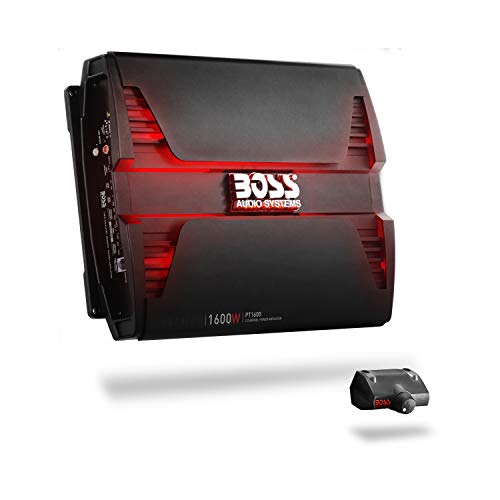
- 1600W max bridged at 4 ohms
- High/low level inputs for flexible installs
- 6-year warranty through Amazon.com
Best For: High-output 2-channel installs with broad input compatibility
High-Power 4-Channel Pick – Pioneer GM-A6704 4-Channel Amp
If you’re comparing bridgeable stereo car amplifiers for a flexible full-system upgrade, the Pioneer GM-A6704 is built for front/rear speaker setups and even subwoofer duty. Its 4-channel Class AB design delivers 1,000 watts max, with 60 watts RMS x 4 at 4 ohms or 190 watts RMS x2 in bridged mode, plus variable high- and low-pass filters for tuning.
Best For: Drivers who want a bridgeable 4-channel amp for speakers up front and back, with the option to bridge for more output.
Pros:
- Bridged output reaches 190 watts RMS x2 for more flexible wiring.
- Class AB design aims for efficient performance with low distortion.
- Built-in high- and low-pass filters help tailor the sound to your setup.
- 4-channel layout works well for balanced front/rear speaker systems.
Cons:
- Large 4-channel format may be more amp than simple two-speaker installs need.
- Best output in bridged mode still depends on matching the right speaker load.
This is a practical choice if you want a bridgeable stereo car amplifier that can grow with your system. It gives you multiple configuration options without losing the straightforward, everyday usability that many car audio upgrades need.
Compact Full-Range Option – PRV Audio QS400.4 Mini Amp
For shoppers focused on compact bridgeable stereo car amplifiers, the PRV Audio QS400.4 stands out for its small footprint and full-range Class D design. It delivers 4 x 100 watts RMS at 2 ohms, is stable at 2 ohms, and can be bridged into 2 channels at 4 ohms minimum for 2 x 200 watts RMS.
Best For: Installations that need a tiny, efficient 4-channel amp with bridging flexibility.
Pros:
- Very compact chassis makes installation easier in tight spaces.
- 2-ohm stability gives flexibility when wiring multiple speakers.
- Bridging two channels can double power to selected speakers.
- Class D full-range design emphasizes efficiency.
Cons:
- Requires a 4-ohm minimum per bridged channel, so load matching matters.
- 100 watts RMS per channel is modest compared with larger high-output amps.
The QS400.4 is a strong fit if space and efficiency matter more than raw size. It keeps the bridgeable stereo car amplifier format simple while still offering enough flexibility for a range of speaker setups.
Classic 2-Channel Bridgeable Choice – Pyramid PB715X 1000W Amp
If you want a straightforward bridgeable stereo car amplifier with traditional 2-channel flexibility, the Pyramid PB715X offers 1,000 watts total system output and a MOSFET PWM power supply. It delivers 2 x 500 watts at 4 ohms, supports tri-way configuration, and adds subwoofer crossover and protection features for everyday use.
Best For: Buyers who want a 2-channel amp with bridging-friendly versatility and built-in protection.
Pros:
- 2 x 500 watts at 4 ohms provides strong stereo output.
- Tri-way configuration supports flexible 2-channel use.
- Thermal, short-circuit, and fuse protection add peace of mind.
- Subwoofer crossover and 90dB SNR support cleaner system integration.
Cons:
- It is a 2-channel design, so it is less flexible than a 4-channel amp for full-system expansion.
- Requires careful setup with load and wiring to get the most from bridged use.
The PB715X makes sense if your goal is a dependable amp with clear bridgeable capability rather than a feature-heavy modern layout. Its protection features and simple 2-channel format are easy to work into many car audio builds.
Budget Bridgeable 2-Channel Pick – Pioneer GM-A3702 500W Amp
The Pioneer GM-A3702 is a compact choice in bridgeable stereo car amplifiers if you want a simple 2-channel setup with easy tuning. It offers 500 watts max, 60 watts RMS x 2 at 2 ohms, and 190 watts RMS x 1 in bridged mode, plus automatic signal sensing turn-on and a built-in low-pass filter.
Best For: Drivers who want a straightforward 2-channel amp that can be bridged for a single higher-power speaker.
Pros:
- 190 watts RMS x 1 in bridged mode gives you a clear power option for one speaker.
- Automatic signal sensing turn-on simplifies installation.
- Built-in low-pass filter helps with bass-focused tuning.
- Class AB design aims to balance efficiency and sound quality.
Cons:
- 2-channel layout is less versatile than a 4-channel amp for multi-speaker systems.
- Best suited to simpler systems rather than full cabin upgrades.
This amp is a practical, no-frills option if you want bridgeable performance without moving to a larger 4-channel design. It keeps the setup approachable while still giving you the bridged output many car audio installs need.
High-Power Budget Pick – Pyle 2-Channel 2000W Bridgeable Amp
If you’re comparing bridgeable stereo car amplifiers for a compact install, the Pyle PLA2378 is built around raw output and flexible tuning. It offers up to 2000W bridgeable power, a configurable crossover network, switchable bass boost, and variable gain control, making it a practical fit for systems that need strong output from a small chassis.
Best For: Drivers who want a small, bridgeable amp with high power and basic sound-shaping controls.
Pros:
- Up to 2000W bridgeable output for high-power setups
- MOSFET power supply aims for clean, distortion-free signal delivery
- Includes bass boost, variable gain, and electronic crossover controls
- Silver-plated RCA ports and subsonic filter support cleaner signal handling
Cons:
- Two-channel design limits how many speakers you can run directly
- Focused on compact size, so it may not suit larger multi-amp builds
- Power claims are much higher than the listed 200W output power spec
The PLA2378 is a straightforward option if you want a bridgeable stereo car amplifier with a small footprint and plenty of adjustment features. Its protection circuitry and slim design add everyday practicality, but it’s best suited to buyers who prioritize form factor and tuning over a more refined feature set.
Balanced Performance Choice – Pioneer GM-A5702 Bridgeable Class AB Amp
The Pioneer GM-A5702 is a solid middle-ground pick among bridgeable stereo car amplifiers, especially if you want dependable Class AB performance rather than extreme power numbers. It delivers 1,000 watts max, 240 watts RMS x 2 at 2 ohms, or 480 watts RMS x 1 in bridged mode, plus variable filters and bass boost for tuning the sound.
Best For: Buyers who want a reliable bridgeable 2-channel amp for cleaner, controlled car audio.
Pros:
- 480 watts RMS x 1 in bridged mode for flexible system setup
- Class AB design balances power and efficiency
- Variable low-pass filter helps reduce distortion and improve clarity
- Adjustable bass boost adds low-end tuning options
Cons:
- Max power is lower than some higher-output competitors
- Still limited to 2 channels
- Surface-mount size may not be ideal for every installation layout
For shoppers who want bridgeable stereo car amplifiers with a more measured, performance-focused approach, the GM-A5702 is easy to recommend. It emphasizes clean output, useful filtering, and sensible power handling, which makes it a practical fit for many everyday car audio systems.
Compact Entry-Level Option – BOSS R1002 Full-Range Bridgeable Amp
The BOSS Audio Systems R1002 is a compact choice for buyers browsing bridgeable stereo car amplifiers on a tighter budget. It’s a full-range 2-channel amp with low- and high-level inputs, variable input gain control, and 2-to-8 ohm stability, so it can work with both speakers and subwoofers in simpler systems.
Best For: Budget-minded shoppers who want a small bridgeable amp for basic speaker or subwoofer setups.
Pros:
- Full-range design works with speakers or subwoofers
- Supports low- and high-level inputs for broader compatibility
- 2 to 8 ohm stable for flexible installation options
- Very small and lightweight for easy placement
Cons:
- Lower maximum output than the higher-powered options here
- Only 2 channels, so system expansion is limited
- Best suited to basic setups rather than demanding builds
If you need an affordable bridgeable amp with simple controls and a compact footprint, the R1002 covers the essentials. It’s not the most powerful model in this group, but its full-range design and broad input support make it a practical entry point for smaller car audio upgrades.
Compact Power Pick – Pyle 2-Channel 1400W Bridgeable Amp
If you’re comparing bridgeable stereo car amplifiers for a small install, the Pyle PLA2200 is built around straightforward power and simple tuning. It delivers up to 1400W bridgeable output, adds variable gain and bass boost controls, and includes a configurable crossover network to help match the amp to your speakers.
Best For: Drivers who want a slim, bridgeable 2-channel amp with basic sound-shaping controls and easy placement.
Pros:
- Up to 1400W bridgeable output for larger power needs
- Gold-plated RCA ports help reduce signal loss
- MOSFET power supply aims for clean, distortion-free signal delivery
- Slim 1.38-inch design makes installation easier in tight spaces
Cons:
- Only a 2-channel design, so it is less flexible than multi-channel amps
- No detailed RMS ratings were provided in the supplied notes
- Best fit is for users comfortable with manual tuning
The PLA2200 makes the most sense if you want a compact bridgeable stereo car amplifier with protection features and enough built-in adjustment to tailor the sound without taking up much room.
Versatile Multichannel Choice – Recoil Full-Range 4-Channel Bridgeable Amp
For shoppers looking at bridgeable stereo car amplifiers with more flexibility, the Recoil DI550.4 stands out as a full-range 4-channel option. It is rated at 1040 watts max power, supports 2-4 ohm operation, and offers bridged output of 260 watts x 2 at 4 ohms, making it adaptable for different system layouts.
Best For: Users who want a bridgeable 4-channel amplifier with adjustable controls and a compact footprint.
Pros:
- 4-channel class-D design with 1040 watts max power
- Bridged output rated at 260 watts x 2 at 4 ohms
- High-speed MOSFET power supply and 4-way protection circuitry
- Adjustable gain, LPF, HPF, crossover, and bass EQ
Cons:
- Power ratings are listed in max and RMS terms, so buyers need to compare carefully
- Not as simple as a basic 2-channel amp if you only need a minimal setup
- Smaller amp body may not suit those wanting a more traditional larger chassis
The DI550.4 is a strong pick if you want bridgeable stereo car amplifier performance plus the added routing options of a 4-channel layout and a wide set of controls.
High-Output Budget Option – BOSS Phantom 2-Channel Bridgeable Amp
The BOSS Audio Systems PT1600 is a bridgeable 2-channel option for buyers who want strong output and broad compatibility in bridgeable stereo car amplifiers. It lists 1600 watts max bridged at 4 ohms, supports 2/4 ohm setups, and includes high/low level inputs plus high/low pass crossover controls for system matching.
Best For: Drivers who want a bridgeable 2-channel amp with high output, flexible inputs, and a long warranty.
Pros:
- 1600 watts max bridged at 4 ohms
- High/low level inputs expand install compatibility
- High/low pass crossover and variable bass boost provide tuning control
- 6-year Platinum Online Dealer Warranty when purchased through Amazon.com
Cons:
- Larger and heavier than the compact 2-channel options here
- Gain control is for signal matching, not direct volume adjustment
- Professional installation is recommended by the manufacturer
If your priority is raw bridged output with flexible input options, the PT1600 is a practical contender, especially for systems where warranty coverage and compatibility matter.
How We Picked These Bridgeable Stereo Car Amplifiers
We prioritized amplifiers that are actually useful in real-world car audio builds: bridgeable output, sensible power ratings, stable impedance support, installation-friendly inputs, and features that help with tuning. We also gave weight to brands and models that are commonly chosen for entry-level to midrange upgrades, where value and flexibility matter most.
Quick Comparison: What Matters Most
When comparing Bridgeable Stereo Car Amplifiers, think beyond peak wattage. A higher max power number does not always mean better sound or a better fit. Look at RMS power, channel count, minimum impedance, and whether the amp is better suited for full-range speakers or a dedicated subwoofer bridge.
In simple terms: 2-channel amps are often best for bridging to a sub or powering a pair of speakers, while 4-channel amps are better if you want front-and-rear speaker control or plan a more complete system.
Key Buying Factors for Bridgeable Stereo Car Amplifiers
Power and RMS Ratings
Match the amplifier’s real power output to your speakers’ RMS handling, not just the advertised peak number. Underpowering can be just as problematic as overdriving a speaker if you push the amp into distortion.
Bridgeability and Load Stability
Not every amp bridges the same way, and not every bridged setup is safe at every impedance. Check whether the amplifier supports 2-ohm or 4-ohm operation and confirm the bridged load requirement before buying.
Channels and System Goals
Choose 2-channel if you want a simple high-power setup, or 4-channel if you need more flexibility for front/rear speakers, coaxials, or a mixed build. Bridgeable Stereo Car Amplifiers are especially useful when you want one amp to do more than one job.
Controls, Filters, and Inputs
High-pass and low-pass filters, variable crossovers, and both high- and low-level inputs can make installation easier and improve tuning. These features matter if you are integrating the amp with a factory radio or balancing sound across multiple speakers.
Size, Heat, and Installation Space
Compact models are easier to mount, but they still need enough airflow. If your install space is tight, a smaller Class D option may be a better fit; if sound quality and speaker duty matter more, a Class AB design can be attractive.
Who Should Buy Which Bridgeable Stereo Car Amplifiers?
If you want a simple, affordable upgrade for a pair of door speakers or a single sub, a basic 2-channel bridgeable amp is usually the smartest choice. If you are building a fuller system with front and rear speakers, a 4-channel amp gives you more routing flexibility.
Drivers using factory head units should look closely at high-level input support and automatic turn-on features. Shoppers chasing the easiest compact install should favor smaller Class D designs, while those prioritizing traditional full-range performance may prefer Class AB options. The best amp is the one that fits your speakers, your space, and your tuning goals—not just the biggest number on the box.