If you’re an audiophile looking to elevate your car audio experience in 2026, you’ll want to explore the best parametric equalizers available. These devices can greatly enhance sound quality by allowing precise tuning to your preferences. With various models and features from top brands, finding the right equalizer can be a game-changer in your listening journey. Discover which options stand out and why they might be the perfect fit for your setup.
CT Sounds CT-7EQ 7 Band 1/2 Din Parametric Car Audio Equalizer
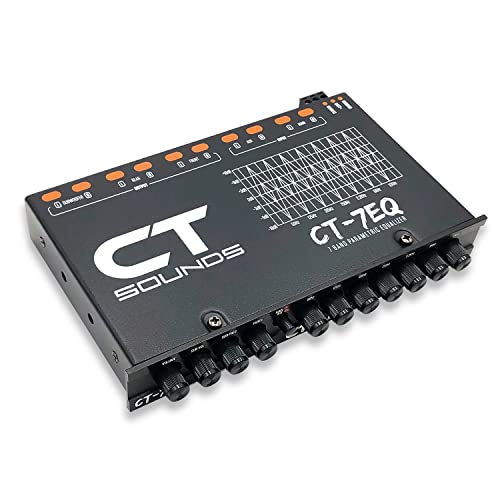
If you’re an audiophile looking to elevate your car audio experience, the CT Sounds CT-7EQ 7 Band 1/2 Din Parametric Car Audio Equalizer is a standout choice. This equalizer segments the frequency range from 20Hz to 20kHz into seven precise bands, letting you fine-tune your sound. You’ll enjoy a robust frequency response of 25Hz to 50kHz and an impressive output level of +16dB. With adjustable bass, mid, and treble settings of ±10dB, you can tailor your audio to perfection. Plus, installation brackets and hardware are included, making setup easy. Elevate your listening experience with this exceptional equalizer!
Best For: Audiophiles seeking to enhance and customize their car audio experience with precise frequency adjustments.
Pros:
- Fine-tuning capabilities with 7 frequency bands for personalized sound.
- Wide frequency response range of 25Hz to 50kHz ensures rich audio quality.
- Easy installation with included brackets and hardware.
Cons:
- Requires some technical knowledge for optimal setup and adjustments.
- Limited to 1/2 din size, which may not fit all vehicle audio systems.
- No built-in display, making it difficult to see adjustments at a glance.
Clarion EQS755 7-Band Car Audio Graphic Equalizer
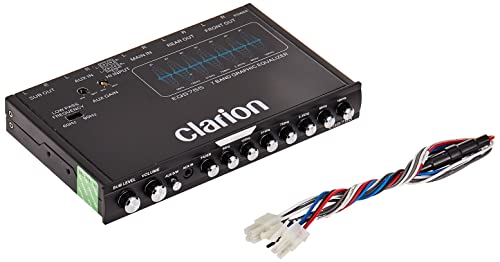
The Clarion EQS755 7-Band Car Audio Graphic Equalizer stands out for its extensive 7-band frequency adjustment, making it an ideal choice for audiophiles seeking precise control over their sound. With a compact 1/2-DIN chassis, it fits neatly in your vehicle. You’ll appreciate the built-in low-pass filter, adjustable from 60Hz to 90Hz, and the 6-channel RCA outputs delivering an impressive 8-Volt output. Independent master and subwoofer volume controls let you fine-tune your audio experience. Plus, the ground loop isolation circuit helps eliminate unwanted noise. Although discontinued, it remains a solid option for enhancing your car’s audio system.
Best For: Audiophiles and car audio enthusiasts seeking precise sound control and enhancement in their vehicle’s audio system.
Pros:
- 7-band frequency adjustment allows for detailed sound customization.
- Built-in low-pass filter helps to tailor bass response effectively.
- Compact 1/2-DIN design fits easily into most car audio setups.
Cons:
- Discontinued by manufacturer, making replacement parts harder to find.
- Requires a 9V battery, which may necessitate periodic replacements.
- Limited availability due to being discontinued, potentially affecting purchase options.
PRV AUDIO Car Audio DSP Digital Crossover and Equalizer

For audiophiles seeking precise control over their sound, the PRV AUDIO Car Audio DSP Digital Crossover and Equalizer stands out with its 15-band graphic equalizer and parametric equalizer features. You’ll appreciate the intuitive interface and clear LCD display, making real-time adjustments a breeze. With two audio inputs and four independent outputs, you can easily route and process your audio. The parametric equalizer allows you to fine-tune gain, frequency, and bandwidth for customized sound. Plus, its sequencer functionality lets you trigger other devices effortlessly, enhancing your overall audio experience. This unit truly empowers you to craft the perfect sound in your vehicle.
Best For: Audiophiles and car audio enthusiasts looking for advanced sound control and customization options in their vehicle’s audio system.
Pros:
- Intuitive interface with a clear LCD display for easy navigation and real-time adjustments.
- Versatile audio routing with two inputs and four independent outputs, allowing for customized audio configurations.
- Advanced equalization options, including a 15-band graphic equalizer and parametric equalizer for detailed sound tuning.
Cons:
- May require a learning curve for users unfamiliar with digital audio processing equipment.
- Higher price point compared to basic crossovers and equalizers, which might not be suitable for budget-conscious consumers.
- Installation may be complex, necessitating professional assistance for optimal performance and integration.
Clarion EQS755V 7-Band Car Audio Equalizer/Crossover

Audiophiles seeking precise sound control will appreciate the Clarion EQS755V 7-Band Car Audio Equalizer/Crossover. This compact 1/2-DIN unit offers a robust 7-band equalizer, allowing you to fine-tune frequencies from 50Hz to 16kHz. With independent master volume and subwoofer level controls, you can balance your sound to perfection. Plus, the rear RCA and front 3.5mm auxiliary inputs provide versatile connectivity options. The 6-channel, 8-volt RCA outputs guarantee clean audio delivery, while the selectable low-pass filter enhances bass performance. With blue illumination and noise reduction features, the EQS755V combines functionality and style for any audiophile’s setup.
Best For: Audiophiles and car audio enthusiasts seeking customizable sound control and premium audio performance in their vehicles.
Pros:
- 7-band equalizer allows for precise frequency adjustments from 50Hz to 16kHz.
- Versatile connectivity options with multiple input types, including RCA and auxiliary inputs.
- Selectable low-pass filter enhances bass performance for a richer audio experience.
Cons:
- Limited to 1/2-DIN size, which may not fit all car audio setups.
- Requires additional installation knowledge or professional help for optimal setup.
- No built-in amplifier, necessitating the use of external amplification for enhanced sound output.
PRV AUDIO Car Audio DSP Digital Crossover and Equalizer
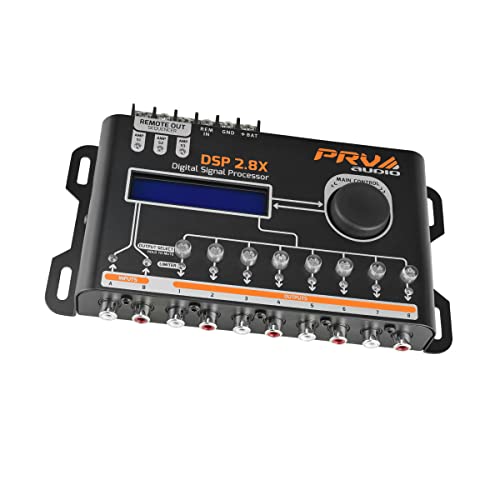
With its 8-channel full digital signal processor, the PRV AUDIO Car Audio DSP 2.8X stands out as an excellent choice for those seeking precise audio control in their vehicles. You’ll appreciate the intuitive interface featuring a 16×2 character LCD display for real-time adjustments. This DSP offers two audio inputs, allowing you to select different sources for each output. Its 15-band graphic equalizer and 12 presets cater to various music styles, ensuring your audio sounds just right. Plus, the parametric equalizer and sequencer functionality enhance integration with other equipment, giving you ultimate control over your sound experience.
Best For: Audiophiles and car audio enthusiasts seeking precise control and customization of their vehicle’s sound system.
Pros:
- Intuitive interface with a 16×2 character LCD display for easy real-time adjustments.
- Versatile equalization options with a 15-band graphic equalizer and 12 presets tailored for various music genres.
- Enhanced integration with additional audio equipment through sequencer functionality and remote trigger connection.
Cons:
- Complexity may be overwhelming for casual users who prefer simpler audio systems.
- Requires installation expertise, which may necessitate professional setup for optimal performance.
- Limited to vehicle use, making it less versatile for home audio applications.
Taramp’s Pro 2.4S DSP Crossover Digital Signal Processor and Equalizer

Designed for those who crave precise sound control, the Taramp’s Pro 2.4S DSP Crossover Digital Signal Processor and Equalizer stands out with its 15-band graphic equalization. You’ll appreciate the adjustable parameters that allow you to boost or attenuate frequencies from 25Hz to 16kHz. With high and low pass filters ranging from 10Hz to 22kHz, you can tailor your sound to perfection. The 12 preset EQs cater to various music styles, ensuring you find the ideal setting for your listening experience. Plus, adjustable output levels give you the power to enhance your audio up to +15dB, making it a versatile choice for audiophiles.
Best For: Audiophiles and sound engineers seeking precise control over their audio with customizable equalization and crossover settings.
Pros:
- Versatile equalization with 15 bands and adjustable parameters for targeted sound enhancement.
- Multiple preset EQs tailored to different music styles for quick and easy adjustments.
- Flexible crossover capabilities with various filter types and slopes to optimize sound performance.
Cons:
- Complexity may be overwhelming for casual users unfamiliar with audio processing.
- Requires careful tuning to achieve the desired sound, which may be time-consuming.
- Potential compatibility issues with certain audio systems if not properly configured.
Skar Audio SKA7EQ 7 Band Car Audio Graphic Equalizer
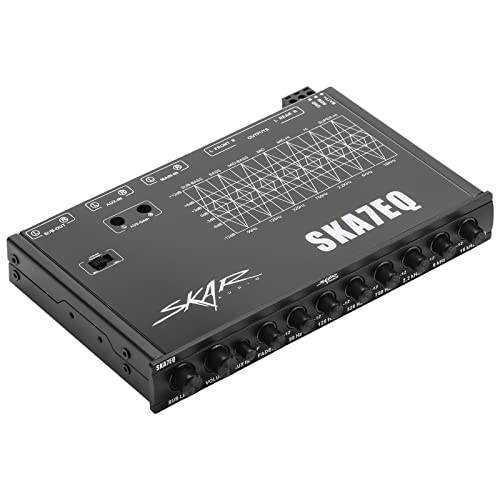
For those seeking precise sound control in their car audio system, the Skar Audio SKA7EQ 7 Band Car Audio Graphic Equalizer stands out as an excellent choice. With 7 fully adjustable EQ bands, you can tailor your sound from -12 dB to +12 dB across various frequencies. Featuring 6 channels, it offers 2 RCA inputs and gold-plated pre-amp outputs for ideal connectivity. The built-in fader and variable subwoofer control let you dial in your perfect audio experience. Plus, with a low total harmonic distortion of just 0.005%, you’ll enjoy crystal-clear sound. Installation is a breeze with included mounting hardware.
Best For: Audiophiles and car audio enthusiasts looking for precise sound control and customization in their vehicle’s audio system.
Pros:
- 7 fully adjustable EQ bands allow for tailored sound adjustments across a wide range of frequencies.
- High-quality components with gold-plated RCA outputs ensure optimal connectivity and minimal signal loss.
- Low total harmonic distortion (0.005%) provides clear and accurate sound reproduction.
Cons:
- Installation may require technical expertise, which could be challenging for beginners.
- Limited to car audio systems, not suitable for home audio setups.
- No built-in amplification, which may require additional equipment for optimal performance.
Professional 7 Band Car Equalizer Audio EQ Tuning

Audiophiles seeking to elevate their car audio experience will find the Professional 7 Band Car Equalizer an excellent choice. This multifunctional EQ tuning crossover amplifier offers variable gain adjustment and high-level speaker input, ensuring you can customize your sound perfectly. With 6-channel outputs for front, rear, and subwoofers, you’ll enjoy an all-encompassing audio experience. The compact design features high-quality rotary knobs, making adjustments intuitive and enjoyable. Customers rate it 4.5 out of 5 stars, reflecting its popularity. Plus, it comes with a 30-day return guarantee from Amazon, ensuring your satisfaction with this essential audio upgrade.
Best For: Audiophiles looking to enhance their car audio experience with customizable sound options.
Pros:
- High-quality sound customization with 7-band equalization.
- Compact design with user-friendly rotary knobs for easy adjustments.
- Versatile connectivity options, including 6-channel outputs and CD/Aux input.
Cons:
- Limited to 6-channel output, which may not suffice for larger setups.
- Requires professional installation for optimal performance.
- May not be compatible with all car models without additional adapters.
Stetsom EQX764-7 Band Equalizer for Car Audio

The Stetsom EQX764-7 Band Equalizer stands out as an excellent choice for car audio enthusiasts who crave precise sound tuning. With 7 equalization bands, each offering a generous 12 dB range, you can easily enhance bass, mids, and highs across key frequencies. Its robust design simplifies installation and adjustments. You’ll appreciate the 4 input and 6 output channels, accommodating multiple audio sources and amplifiers. Plus, with dedicated controls for level and frequency, you can achieve the perfect balance. The blue LED illumination guarantees you can adjust settings effortlessly, even in low light, all while delivering exceptional audio performance.
Best For: Car audio enthusiasts seeking precise sound tuning and multiple audio source compatibility.
Pros:
- Robust design simplifies installation and adjustments.
- 7 equalization bands allow for detailed sound customization across various frequencies.
- Blue LED illumination makes it easy to adjust settings in low light conditions.
Cons:
- May require professional installation for optimal performance.
- Limited to 4 input channels which may be restrictive for some users.
- Higher output voltage may not be compatible with all amplifiers.
Audiopipe 9 Band Graphic Equalizer with 9 V LINE Driver (EQ-909X)
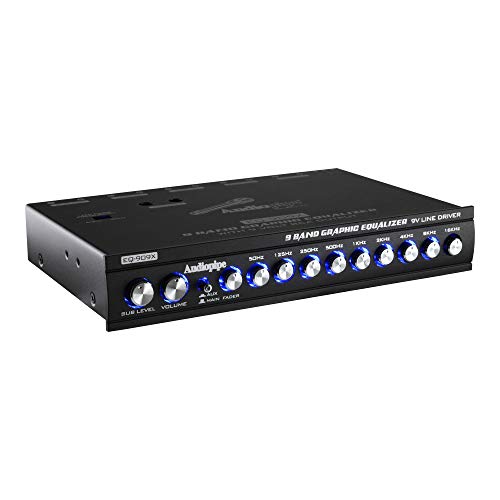
When you’re serious about audio quality, the Audiopipe 9 Band Graphic Equalizer with 9 V LINE Driver (EQ-909X) stands out with its impressive frequency response of 10Hz to 50kHz, ensuring every note is crystal clear. This equalizer features nickel-plated locking knobs for durability and a sleek design, along with gold-plated RCA connectors for superior conductivity. You can fine-tune your sound with adjustable subwoofer frequencies and 12dB amplitude adjustments across all bands. With a universal half-din chassis and a main/auxiliary input selector, installation is a breeze, making this equalizer a fantastic choice for audiophiles seeking top-tier performance.
Best For: Audiophiles and music enthusiasts looking for precise audio control and superior sound quality in their audio systems.
Pros:
- Enhanced audio clarity with a frequency response of 10Hz-50kHz.
- Durable design featuring nickel-plated knobs and gold-plated RCA connectors for optimal conductivity.
- Easy installation with a universal half-din chassis and versatile input options.
Cons:
- Limited to 12dB amplitude adjustments, which may not be sufficient for some users.
- Requires additional space in the audio system due to its half-din chassis size.
- May be overkill for casual listeners who do not require extensive audio customization.
Factors to Consider When Choosing Parametric Car Audio Equalizers
When choosing a parametric car audio equalizer, you need to take into account several key factors. Frequency range coverage and the number of bands play an essential role in shaping your sound. Additionally, look at output voltage levels, input options, and control features to guarantee you get the best performance for your setup.
Frequency Range Coverage
Choosing the right frequency range coverage is essential for getting the best performance from your parametric car audio equalizer. A standard range of 20Hz to 20kHz encompasses the full spectrum of human hearing, but if you’re aiming for high fidelity, consider equalizers that extend from 25Hz to 50kHz. This broader range enhances audio detail and clarity. Look for equalizers that divide the frequency response into specific bands, allowing you to adjust key frequencies like 50Hz for bass or 750Hz for mid-range. A seven-band equalizer typically covers vital frequencies, but advanced models with more bands or presets can provide greater flexibility. Tailoring sound to your preferences becomes easier with the right frequency range coverage.
Number of Bands
After understanding the importance of frequency range coverage, the next factor to evaluate is the number of bands in your parametric car audio equalizer. Typically, you’ll find equalizers ranging from 5 to 15 bands. More bands allow for finer adjustments across the frequency spectrum, enabling precise tuning for bass, mids, and treble. For instance, a common 7-band equalizer divides the audio spectrum into specific segments like 50Hz and 125Hz, which lets you target certain frequencies effectively. While fewer bands simplify tuning, they may lack the customization needed for complex sound environments. Ultimately, your choice should align with your audio preferences and your vehicle’s acoustic characteristics to achieve the best sound quality.
Output Voltage Levels
Output voltage levels play an essential role in your car audio system’s overall sound quality. Most parametric car audio equalizers offer maximum output voltages between 7V and 9V, which enhance signal transfer to amplifiers. Opting for a higher output voltage, like +16dB, gives you increased headroom, minimizing distortion while preserving audio clarity during playback. Pay attention to the signal-to-noise ratio (SNR) as well; a higher SNR, such as 100 dB, means less background noise, resulting in cleaner audio output. Look for equalizers that let you adjust output levels for each channel, allowing you to tailor sound to your preferences and vehicle acoustics. Consistent output across channels guarantees a balanced and cohesive audio experience.
Input Options Available
When selecting a parametric car audio equalizer, the variety of input options greatly impacts your system’s versatility and performance. Many equalizers come with RCA inputs for auxiliary sources and high-level speaker inputs for direct amplifier connections. Look for models that offer dual audio inputs (A and B), making it easier to route and process audio from different sources. Some equalizers even feature 3.5mm auxiliary inputs for seamless connectivity with portable devices. Additionally, variable gain adjustments on certain inputs let you customize sound levels for better compatibility. Input channel selection options, like MAIN or HIGH, allow you to prioritize signals based on their source, ensuring peak audio performance tailored to your preferences.
Control Features Offered
Control features in parametric car audio equalizers are essential for achieving the perfect sound experience tailored to your preferences. Look for independent master volume and subwoofer level controls, which let you manage sound precisely. Many equalizers also include dedicated LEVEL and FREQUENCY controls for sub outputs, enhancing bass performance to your liking. Fader control balances audio output between front and rear channels, ensuring an immersive listening experience. Additionally, some models offer various filter options, like adjustable low-pass filters, to further refine sound quality. If you want real-time adjustments, advanced equalizers with LCD displays and intuitive interfaces make maneuvering through settings a breeze. These features empower you to create the ideal audio environment in your vehicle.
Design and Build Quality
Choosing the right parametric car audio equalizer involves paying close attention to its design and build quality, as these factors greatly impact both functionality and durability. Look for a compact chassis, typically 1/2 DIN size, that fits easily in your vehicle’s audio system. High-quality materials, like metal chassis and durable rotary knobs, guarantee longevity against wear and tear. Features such as blue LED illumination enhance visibility and usability, especially in low-light conditions, making it easier for you to make quick adjustments while driving. Additionally, a user-friendly interface simplifies audio tuning, allowing you to customize sound profiles effortlessly. A robust design, including ground loop isolation circuits, also minimizes noise interference, enriching your overall audio experience.
Installation Requirements
Installing a parametric car audio equalizer requires careful consideration of several factors to guarantee a smooth setup. First, make certain the equalizer’s dimensions fit within your vehicle’s available space, typically requiring a 1/2 DIN chassis for compact installations. Next, check for included installation brackets and hardware, as these can simplify the process. Consider the number of input and output channels to ascertain compatibility with your audio system. Also, verify the power requirements, such as maximum supply voltage, to avoid damaging the equalizer or your vehicle’s electrical system. Finally, assess the ease of access to knobs and controls for adjustments, along with the visibility of indicators during installation, to enhance your overall experience.
Price and Value
Steering through the world of parametric car audio equalizers requires a keen understanding of price and value to guarantee you’re making an informed investment. Start by evaluating the number of frequency bands; more bands typically mean greater sound customization. Next, consider the output voltage capability; higher outputs like 8V or 9V usually indicate better performance with amplifiers. Check if installation components are included, as missing brackets or hardware can drive up costs. Advanced features such as built-in filters, remote controls, and preset settings can justify a higher price tag, adding significant value. Finally, don’t overlook customer reviews; they offer valuable insights into long-term performance and reliability, helping you determine if the price reflects the quality you’re seeking.