When you’re looking to upgrade your car’s audio system, selecting the right line output converter is essential. These devices bridge the gap between factory and aftermarket systems, ensuring you get the sound quality you desire. With options like the Kicker K-Series and PAC LP7-2, you can enjoy features that simplify installation and enhance performance. But how do you know which converter is best for your needs? Let’s explore the top choices available.
Kicker K-Series Stereo Line-Output Converter (46KISLOC2)

If you’re looking to add an amplifier to your existing radio system without a hassle, the Kicker K-Series Stereo Line-Output Converter (46KISLOC2) is an excellent choice. This converter delivers true sonic accuracy at any volume, preserving the sparkling highs and thunderous lows of your original audio. It converts factory speaker signals into RCA signals effortlessly, using your factory speaker wires for easy installation. Plus, it offers a powerful 100 milli-amp, 12-volt remote wire with DC offset, accommodating up to 55 watts of input signal. Upgrade your audio experience with this reliable, efficient converter that enhances your sound system seamlessly.
Best For: Those looking to enhance their car audio system by adding an amplifier without complicated installation.
Pros:
- Easy Installation: Utilizes factory speaker wires, making setup straightforward.
- High Audio Quality: Delivers true sonic accuracy, preserving both highs and lows.
- Remote Turn-On Output: Features a powerful 100 milli-amp, 12-volt remote wire for convenience.
Cons:
- Limited Input Power: Accepts a maximum of 55 watts, which may not be sufficient for high-powered systems.
- Requires Additional Amplifier: This converter alone does not improve sound quality; an external amplifier is needed.
- Potential Compatibility Issues: May not be compatible with all factory radio systems.
PAC LP7-2 L.O.C. PRO Series 2-Channel Line Output Converter

The PAC LP7-2 L.O.C. PRO Series 2-Channel Line Output Converter is your go-to solution for optimizing audio levels between your radio and amplifier. With dimensions of 4in. x 8in. x 1in., it fits easily into tight spaces. This converter’s designed to achieve the best audio quality, making it perfect for adding an amplifier to your OEM system. You can configure it for either speaker level or RCA level input/output. Plus, the single dial allows for precise stereo level gain adjustments, ensuring you get the sound you want. Elevate your vehicle’s audio setup effortlessly!
Best For: Users looking to enhance their vehicle’s audio systems with OEM setups through improved audio level optimization.
Pros:
- Versatile Configuration: Can be set up for both speaker level and RCA level input/output.
- Compact Size: Fits easily into tight spaces with dimensions of 4in. x 8in. x 1in.
- Precision Adjustment: Single dial for precise stereo level gain adjustments for optimal sound quality.
Cons:
- Limited Channels: Only supports 2-channel audio systems, which may not be sufficient for larger setups.
- OEM Focused: Primarily designed for OEM systems, which may not cater to all aftermarket audio needs.
- Installation Complexity: May require additional knowledge for installation, potentially complicating the process for novice users.
Scosche LOC2SL Line Output Converter for Car Audio

For car audio enthusiasts looking to elevate their sound system, the Scosche LOC2SL Line Output Converter is an excellent choice. This compact, durable converter easily fits into tight spaces and transforms speaker level signals into RCA line level signals, enhancing your audio experience. With its crisp sound quality, it’s perfect for driving subwoofers and provides a reliable boost to your system’s performance. The LOC2SL minimizes signal interference and comes with Scosche’s Lifetime Tech Support, ensuring you have assistance when needed. Enjoy the flexibility and compatibility that makes this converter a go-to solution for any car audio setup.
Best For: Car audio enthusiasts seeking to enhance their sound system with high-quality audio performance.
Pros:
- Versatile compatibility with a wide range of car audio systems.
- Compact design allows for easy installation in tight spaces.
- Delivers crisp sound quality while minimizing signal interference.
Cons:
- May require additional components for full setup depending on the vehicle.
- Some users may find the installation process challenging without prior experience.
- Limited to converting speaker level signals to RCA, which may not suit all audio needs.
Recoil LOC4 Four Channel Speaker Cable to RCA Line Output Converter

When you’re looking to upgrade your factory audio system, the Recoil LOC4 Four Channel Speaker Cable to RCA Line Output Converter stands out as a top choice. This converter efficiently transforms your factory radio’s speaker level output into low amplifier RCA level input, making it ideal for adding an amplifier. With its four-channel adjustable setup, you can easily customize your audio experience. Plus, it features a remote turn-on output for added convenience. The built-in audio transformer guarantees noise isolation, maintaining clear sound quality. Experience seamless integration of aftermarket amplifiers with your factory audio system using the Recoil LOC4.
Best For: Those looking to enhance their factory audio systems by integrating aftermarket amplifiers with ease.
Pros:
- Versatile Compatibility: Works seamlessly with a variety of factory audio systems to add amplification.
- Adjustable Settings: Four-channel adjustable output allows for tailored audio performance.
- Noise Isolation: Built-in audio transformer ensures clear sound quality by reducing interference.
Cons:
- Installation Complexity: May require professional installation for optimal performance.
- Limited Features: Primarily focused on conversion without additional audio processing options.
- Power Supply Dependency: Requires connection to a remote turn-on power source, which may complicate setup.
Recoil MLOC2 2-Channel Micro Line Output Converter

Compact and powerful, the Recoil MLOC2 2-Channel Micro Line Output Converter is perfect for car audio enthusiasts looking to enhance their sound systems without sacrificing space. This tiny converter handles up to 80 watts of input, delivering an impressive 10 volts of output while maintaining a flat frequency range of 20Hz-20kHz. Its 60 Ohm loads guarantee uninterrupted audio playback, and the 99.99% oxygen-free copper speaker wire boosts bass response and signal clarity. Easy to install, it includes a 12-volt output for amplifier remote turn-on, complete with an LED indicator, making it an ideal choice for integrating aftermarket amplifiers with factory radios.
Best For: Car audio enthusiasts looking to integrate aftermarket amplifiers with factory radios to enhance sound quality without taking up much space.
Pros:
- Compact design allows for easy installation in tight spaces.
- Handles up to 80 watts of input, providing high output voltage of up to 10 volts.
- Made with 99.99% oxygen-free copper for improved bass response and signal clarity.
Cons:
- May require additional wiring for complete installation.
- Limited to 2-channel applications, which may not suit all setups.
- Not suitable for high-power aftermarket radios without proper configuration.
RECOIL ALOC2 2-Channel Speaker Cable to RCA Adjustable Line Output Converter

If you’re looking to upgrade your factory radio with an amplifier, the RECOIL ALOC2 2-Channel Speaker Cable to RCA Adjustable Line Output Converter is an excellent choice. This converter effectively transforms your radio’s speaker level output to a low-level RCA input, making it easy to integrate an aftermarket amplifier. With its audio transformer, it guarantees noise isolation for a clean sound. You’ll appreciate the +/-0.5 dB linearity from 20-20,000 Hz, providing reliable performance. Plus, the pure Oxygen Free Copper wiring and split pin RCA connector enhance signal integrity, making your audio experience remarkably improved.
Best For: Those looking to enhance their factory radio audio systems by integrating aftermarket amplifiers seamlessly.
Pros:
- High-quality noise isolation thanks to the built-in audio transformer.
- Excellent linearity performance (+/-0.5 dB) across a wide frequency range (20-20,000 Hz).
- Constructed with pure Oxygen Free Copper wire for improved signal integrity.
Cons:
- May require additional installation expertise for optimal setup.
- Limited to 2-channel output, which may not suit all audio system configurations.
- Potential compatibility issues with certain factory radios.
AudioControl LC1i Active Line Driver/Output Converter
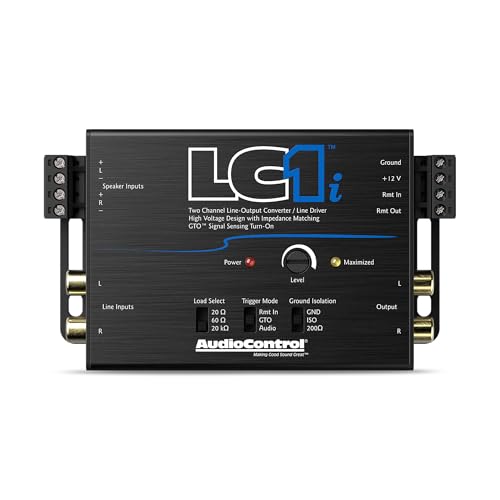
For those looking to enhance their car audio system without sacrificing sound quality, the AudioControl LC1i Active Line Driver/Output Converter is an ideal solution. This active 2-channel line driver and output converter lets you add an amplifier to your factory radio while maintaining distortion-free output. With speaker-level inputs handling up to 40V, it’s compatible with both aftermarket and factory systems. You’ll enjoy up to 9.5 Vrms output, greatly boosting audio performance. Plus, the auto turn-on feature simplifies installation, and the load selection switch guarantees reliable integration without shutting down your factory stereo. Upgrade your audio experience effortlessly!
Best For: Those looking to enhance their car audio system while maintaining sound quality and compatibility with factory radios.
Pros:
- Distortion-free output ensures high-quality audio when integrating with amplifiers.
- Compatibility with factory and aftermarket systems, accommodating a wide range of vehicle audio setups.
- Auto turn-on feature simplifies installation and operation without the need for complex wiring.
Cons:
- May require professional installation for optimal performance and compatibility.
- Limited to 2-channel output, which may not suit all multi-channel audio systems.
- Higher price point compared to basic line converters on the market.
NVX XMICROLOC4 600W 4-Channel Speaker Cable to RCA Line Output Converter

The NVX XMICROLOC4 600W 4-Channel Speaker Cable to RCA Line Output Converter is perfect for car audio enthusiasts looking to enhance their factory stereo systems. With its 600W capacity, you can easily integrate aftermarket amplifiers without hassle. The premium input circuit minimizes distortion, ensuring your audio sounds clear and accurate. You’ll appreciate the adjustable outputs, allowing you to fine-tune bass and treble for balanced sound. Plus, the built-in remote turn-on trigger simplifies installation by activating your amplifier whenever the stereo powers on. Its compact design fits in tight spaces, making it ideal for any vehicle owner aiming for a sound upgrade.
Best For: Car audio enthusiasts looking to enhance their factory stereo systems with aftermarket amplifiers.
Pros:
- Premium input circuit minimizes distortion for clear and accurate audio signals.
- Adjustable outputs allow for precise control over bass and treble levels, enabling balanced sound tuning.
- Compact design facilitates easy installation in tight spaces without major modifications.
Cons:
- May require professional installation for optimal performance if users are not experienced with car audio systems.
- Limited to 600W capacity, which may not be sufficient for high-power amplifier setups.
- Compatibility with certain factory stereo systems may vary, requiring additional adapters in some cases.
Recoil LOCD Active 2-Channel Line Output Converter Driver

Engineered for audiophiles seeking a seamless connection between their aftermarket amplifiers and OEM radios, the Recoil LOCD Active 2-Channel Line Output Converter Driver stands out with its intelligent signal sensing turn-on circuit. This premium 2-in-1 solution delivers a robust 10V line output signal, ensuring your audio remains crystal clear. You’ll appreciate the input gain adjustments and ultra-low 50m Ohm output, which drives any amplifier cleanly. The removable terminal blocks simplify installation, making it easy to integrate with your vehicle’s system. Plus, the output clipping LEDs provide visual cues for peak performance, enhancing your audio experience effortlessly.
Best For: Audiophiles looking to enhance their audio experience by connecting aftermarket amplifiers to OEM radios with high-quality sound output.
Pros:
- Premium 10V line output ensures clarity and strong audio performance.
- Intelligent signal sensing turn-on circuit simplifies the activation of amplifiers without manual intervention.
- Removable terminal blocks make installation easy and straightforward, accommodating various vehicle setups.
Cons:
- Requires some technical knowledge for optimal installation and adjustment.
- May not be compatible with all OEM radios, depending on the vehicle model.
- Limited to 2-channel output, which may not meet the needs of multi-channel audio systems.
PAC LP7-4 L.O.C. PRO Series 4-Channel Line Output Converter

If you’re looking to enhance your OEM audio system with an amplifier, the PAC LP7-4 L.O.C. PRO Series 4-Channel Line Output Converter is a solid choice. It optimizes audio levels between your radio and amplifier, ensuring superior sound quality. With configurable speaker level or RCA inputs and outputs, you can easily adapt it to your setup. The unique stereo gain control dial allows for precise adjustments, while its robust design supports up to 55 watts per channel. Weighing just 6.4 ounces, it’s easy to install in multiple locations. Plus, you’ll enjoy peace of mind with a 1-year manufacturer warranty.
Best For: This product is best for car audio enthusiasts looking to improve sound quality by integrating an amplifier into their OEM audio systems.
Pros:
- Easy installation with configurable speaker level or RCA inputs and outputs.
- Precision audio control with unique stereo gain controls for optimal sound adjustment.
- Robust performance rated at 55 watts per channel, delivering high-quality audio output.
Cons:
- Discontinued product, which may limit availability in the market.
- Limited warranty period of only one year may not be sufficient for some users.
- Average customer rating of 4.4 out of 5 stars suggests mixed feedback from users.
Factors to Consider When Choosing Line Output Converters With Remote Turn On
When choosing a line output converter with remote turn-on, you should think about several key factors. Consider how the device enhances audio quality, its ease of installation, and whether it’s compatible with your existing signals. Don’t forget to evaluate its output adjustability and power handling capacity to guarantee it meets your needs.
Audio Quality Enhancement
Choosing the right line output converter is essential for enhancing your audio quality, especially if you want to preserve fidelity while preventing distortion. These converters transform speaker-level signals into low-level RCA signals, maintaining clarity and detail. Look for models that feature audio transformers, which provide noise isolation for a cleaner output. Adjustable gain controls let you fine-tune audio levels, ensuring the perfect balance of bass and treble. High-quality converters should maintain a flat frequency response from 20Hz to 20kHz, accurately reproducing all frequencies. Additionally, opt for converters using oxygen-free copper wiring to minimize resistance and interference, further enhancing signal clarity. With these features, you’ll experience a remarkable improvement in your audio performance.
Installation Ease
One of the key factors to evaluate for installation ease in line output converters with remote turn-on is their ability to simplify the process by utilizing factory speaker wires. This eliminates the hassle of complex rewiring, making your job much easier. Many models feature compact designs, allowing you to install them in tight spaces without difficulty. You’ll also find adjustable inputs and outputs on some converters, giving you flexibility to accommodate various audio configurations. Plug-and-play designs, complete with clear instructions, minimize installation time and technical challenges, even for those with limited experience. Some converters even include auto turn-on functionality, activating the amplifier automatically when your stereo powers up, which streamlines the entire installation process.
Signal Compatibility
Installing line output converters with remote turn-on is just the start; understanding signal compatibility is vital for achieving the best audio performance. When choosing an LOC, make certain it can accept speaker-level signals from your factory radio, typically up to 55 watts. Look for converters that handle varying input voltages, as some can accept up to 40V or 400 watts RMS, giving you flexibility with different systems. It’s also important that the LOC supports both high-level and low-level outputs to enhance compatibility with various audio equipment. Finally, check for features like adjustable gain controls to match signal levels and guarantee minimal signal interference, maintaining audio integrity across the full frequency range of 20Hz to 20kHz.
Output Adjustability
When selecting line output converters with remote turn-on, output adjustability plays a key role in enhancing your audio experience. This feature allows you to fine-tune audio levels between your radio and amplifier, ensuring ideal sound quality. Many converters come with a single dial or multiple options to precisely control stereo gain, helping you achieve balanced sound across various audio frequencies. Adjustable outputs also accommodate different amplifier sensitivities, enhancing compatibility in mixed audio systems. Features like individual channel adjustments let you tailor sound to your preferences, enriching your listening experience. Importantly, being able to adjust output levels helps prevent distortion and maintains clarity at high volumes, which is essential for achieving true sonic accuracy.
Power Handling Capacity
Power handling capacity is a crucial aspect to assess for ideal performance when choosing line output converters with remote turn-on. You’ll want to take into account how much wattage the converter can accept from your factory radio’s speaker output. Many converters handle input signals up to 55 watts, allowing you to amplify sound without distortion. Additionally, check the voltage handling; some models can manage up to 40 volts, which is important for compatibility with high-powered factory systems. A high power rating, like 600 watts for 4-channel models, guarantees your converter supports powerful amplifiers without sacrificing audio quality. Finally, make sure the converter maintains linearity across a wide frequency range, ideally from 20 Hz to 20 kHz, for consistent performance at various volume levels.
Size and Design
Choosing the right size and design for your line output converter is crucial for seamless integration into your vehicle’s audio system. A compact size guarantees that installation remains hassle-free, even in tight spaces. Look for a converter made from durable materials, as this will help it withstand the demanding automotive environment. Clear labeling and accessible terminals are essential for straightforward wiring, making the installation process smoother. Some models even come with a remote control knob, allowing you to adjust audio levels conveniently without reaching the unit. Additionally, prioritize designs that promote heat dissipation, as this will help maintain performance and prevent overheating during long drives. With these factors in mind, you’ll enhance both usability and longevity.
Price vs. Performance
While it’s tempting to go for the lowest-priced line output converter, you’ll want to weigh its performance against your needs. Cheaper models often compromise on audio quality and essential features, which can affect your overall sound experience. Look for converters with solid performance metrics, like frequency response and output voltage, as these can enhance sound clarity and amplifier efficiency. Higher-end options frequently offer adjustable gain settings and remote turn-on outputs, making them more user-friendly. Additionally, check the converter’s ability to handle higher input wattage—around 55 watts or more—indicating better performance potential. Investing in a reputable converter may lead to greater long-term audio satisfaction and reliability, making it worth the extra cost for your audio setup.