If your trips take you far from towers, the right booster can make the difference between a dead zone and a usable connection. This roundup of cell signal boosters for overland vehicles focuses on options built for trucks, SUVs, campers, and off-road rigs.
We looked for models that balance gain, carrier compatibility, installation practicality, and real-world range improvement so you can choose a setup that fits your vehicle and travel style.
Best 10 Cell Signal Boosters for Overland Vehicles Picks for 2026
Overland-Ready Signal

- Supports major U.S. carriers and 5G-compatible service
- Rugged outdoor antenna with versatile mounting bracket
- FCC approved with 50 dB max gain and 2-year warranty
Best For: Overlanders wanting a durable, broad-carrier booster
Budget 700MHz Booster

- Covers Band 12/13/17 at 700MHz for supported carriers
- Complete vehicle kit with antennas, cables, and power adapter
- FCC approved with 50dB AGC and sleep mode
Best For: Travelers needing a simple 700MHz vehicle booster
Modular Two-Vehicle Kit
Solid Signal Rover Duo Cross Country

- Kit is built for two vehicles with a movable booster module
- Rugged overland antenna and adjustable mount for trail use
- Supports all major U.S. carriers and is FCC approved
Best For: Owners who want one kit for both a daily driver and a rig
Single-Band Travel Booster

- Focused support for Band 12/13/17 on compatible carriers
- Omni-directional roof antenna with indoor patch antenna
- FCC approved and designed for 5G, 4G LTE, and VoLTE
Best For: Drivers who already know they need Band 12/13/17 support
Roof-Rack Signal Pick
Smart HD Display Booster for SUVs

- Smart HD display shows live indoor/outdoor signal levels.
- Five-band unit supports 3G, 4G LTE, and 5G.
- Designed for SUVs and off-road vehicles with roof racks.
Best For: Roof-rack overlanders who want live signal monitoring and broad carrier support.
Heavy-Duty Travel Boost

- Up to 70dB gain for stronger mobile coverage on the road.
- Smart LCD and AGC simplify setup and signal management.
- Waterproof omnidirectional antenna suits rough travel conditions.
Best For: RV and overland travelers who want high gain, dual-power flexibility, and rugged hardware.
Rugged Antenna Upgrade
weBoost Drive Reach Overland Antenna

- Outside antenna for compatible Drive Reach booster kits.
- Supports 5G and 4G LTE for all U.S. carriers.
- Built to military and NEMA durability standards.
Best For: weBoost Drive Reach owners who need a rugged overland antenna upgrade.
Overland-Ready Multi-Carrier Pick
Truck, RV & Off-Road Signal Booster

- Supports AT&T, T-Mobile, Sprint, and U.S. Cellular
- Up to 70dB gain with multi-device support
- Rugged omnidirectional outdoor antenna
Best For: Overlanders and RV travelers who need broad coverage and easy setup
Easy Roof-Antenna Choice
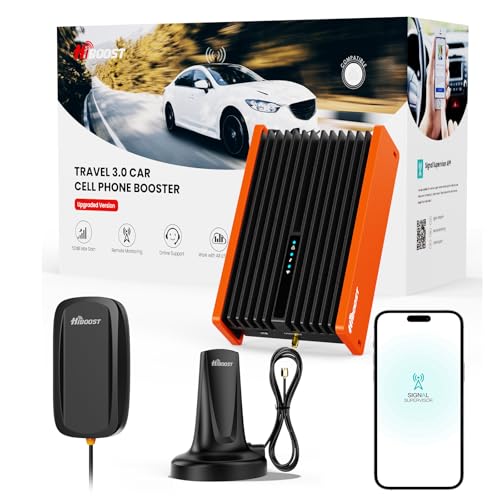
- Works with Verizon, AT&T, and T-Mobile
- Magnetic roof antenna simplifies installation
- Includes app guidance and 3 years of support
Best For: Drivers who want a quick-install booster for cars and SUVs
High-Gain Off-Road Value
Truck, RV & SUV Signal Booster

- Supports Verizon, AT&T, T-Mobile, and more
- 5G and 4G LTE coverage for vehicle use
- Omnidirectional antenna with FCC certification
Best For: Travelers needing a broad-compatibility booster for mixed vehicle use
Overland-Ready Signal – weBoost Drive Reach Overland
If you want cell signal boosters for overland vehicles that are built around rugged travel, the weBoost Drive Reach Overland is a strong all-around pick. It pairs a powerful booster with a tough outdoor antenna and a versatile mounting bracket, and it supports Verizon, AT&T, T-Mobile, U.S. Cellular, and other U.S. carriers. It is also FCC approved and supports the latest 5G technology where compatible.
Best For: Overlanders who want a durable, one-time-install booster for mixed-road trips and broad carrier support.
Pros:
- Supports all major U.S. carriers, including Verizon, AT&T, T-Mobile, and U.S. Cellular
- Built for off-road use with a powerful outdoor antenna and versatile mounting bracket
- FCC approved with up to 50 dB max gain
- Backed by a 2-year warranty and U.S.-based support
Cons:
- Designed for the interior space of a typical overland or off-road vehicle, not larger fixed installs
- Installation is meant to be a one-time setup, so it is less portable than swap-in systems
This is a practical choice if you want a purpose-built overland booster that combines broad carrier compatibility with rugged mounting hardware. It is especially appealing for buyers who want a set-it-and-forget-it solution rather than a more modular kit.
Budget 700MHz Booster – Car Truck SUV RV Kit
For shoppers comparing cell signal boosters for overland vehicles on a tighter budget, this vehicle booster focuses on the 700MHz bands used by Band 12, 13, and 17. It is designed for cars, trucks, SUVs, and RVs, and it includes the booster amplifier, indoor antenna, outdoor antenna, cables, and a power adapter for a complete install. The setup is FCC approved and uses 50dB AGC for automatic gain control.
Best For: Drivers who mainly need a simple Band 12/13/17 booster for highway and travel use.
Pros:
- Supports Band 12, 13, and 17 at 700MHz for compatible 5G and 4G LTE service
- Includes a full vehicle kit with antennas, cables, and a 12V power adapter
- 50dB AGC helps keep operation stable
- FCC approved with LED status indicators and low-power sleep mode
Cons:
- Only works on Band 12/13/17 signals, so it is narrower than multi-band options
- Requires usable outdoor signal to function properly
This is a straightforward vehicle booster for buyers who know their coverage needs are centered on 700MHz support. It is best suited to users who want a complete kit without paying for broader-band features they may not use.
Modular Two-Vehicle Kit – Solid Signal Rover Duo Cross Country
If you want cell signal boosters for overland vehicles with a flexible setup, the Rover Duo Cross Country stands out because it is designed for both a daily driver and an off-road rig. The kit includes hardware for two vehicles, a rugged omnidirectional overland antenna, and a 3-way adjustable mount that folds down for street use and flips up for trail use. It supports 5G and 4G LTE across all major U.S. carriers.
Best For: Overlanders who split time between a commuter vehicle and a trail vehicle.
Pros:
- Includes hardware for two vehicles, so the booster module can move with minimal effort
- Rugged overland antenna and adjustable mount are built for roof racks, ladder bars, or utility rails
- Supports Verizon, AT&T, T-Mobile, and other major U.S. networks
- FCC approved, designed and assembled in the USA, and backed by a 2-year warranty
Cons:
- More complex than a basic single-vehicle booster
- The modular design makes the kit most appealing if you actually use two vehicles
This kit is especially practical if you want to keep one booster system available for both commuting and overlanding. Its modular approach and rugged mounting hardware make it a versatile option for mixed-use vehicle owners.
Single-Band Travel Booster – Phonetone C20 Band 12/13/17
Among cell signal boosters for overland vehicles, the Phonetone C20 is a focused option for drivers who know they need Band 12, 13, or 17 support. It is designed for cars, SUVs, trucks, and RVs, and it uses an omni-directional roof antenna with indoor patch antenna hardware for a simple vehicle setup. The company also notes that it needs at least 2 bars of outdoor signal to work properly.
Best For: Buyers who want a narrow-band booster for compatible 5G and 4G LTE use on the road.
Pros:
- Supports Band 12/13/17 for compatible Verizon, AT&T, T-Mobile, and Straight Talk use
- Omni-directional roof antenna is paired with an outdoor magnetic antenna and indoor patch antenna
- FCC approved with certification number listed by the manufacturer
- Built for 5G and 4G LTE data plus VoLTE on the supported bands
Cons:
- Only works on Bands 12, 13, and 17
- Requires at least 2 bars of outdoor signal before installation
This is a good fit if your travel routes and carrier bands are already known and you want a straightforward booster for them. It is less flexible than wider-band systems, but that narrower focus can be a plus for buyers with clear compatibility needs.
Roof-Rack Signal Pick – Smart HD Display Booster for SUVs
If you want cell signal boosters for overland vehicles that are built around roof-rack mounting, this APlusBoost unit is a practical fit. It supports 3G, 4G LTE, and 5G on five bands, includes a smart HD display for live signal monitoring, and is designed for SUVs and off-road vehicles with roof racks or similar mounts.
Best For: Overlanders with a roof rack who want a five-band booster with live signal readouts and broad U.S. carrier support.
Pros:
- Smart HD display shows indoor and outdoor signal strength in real time.
- Five-band support covers 3G, 4G LTE, and 5G on compatible bands.
- Supports all major U.S. carriers, including Verizon, AT&T, and T-Mobile.
- FCC approved and includes a 3-year warranty.
Cons:
- Requires a vehicle with a roof rack or similar mounting rack.
- You need to confirm your phone’s bands before buying.
This is a focused overland option for drivers who want a mounted booster with simple monitoring and no app dependence. Its main strength is the combination of roof-rack-specific hardware and broad carrier compatibility, but it only makes sense if your vehicle and bands match the design.
Heavy-Duty Travel Boost – 70dB Vehicle Repeater for RVs
For cell signal boosters for overland vehicles that need higher gain and flexible power options, this GLYXIO repeater is built for RVs, trucks, SUVs, campers, and boats. It offers up to 70dB gain, a smart LCD monitor, AGC interference control, and both DC car charger and wall plug power options for road use or campsite setups.
Best For: Travelers who split time between driving and camping and want a high-gain booster with a waterproof outdoor antenna.
Pros:
- Up to 70dB gain helps reduce dropped calls and weak navigation data.
- Smart LCD monitor shows real-time band signal strength.
- Outdoor antenna is waterproof, shockproof, and wear-resistant.
- AGC technology helps manage interference automatically.
Cons:
- Verizon support is limited and does not include Band 13.
- Performance depends on having at least 1 bar of outdoor signal.
This is a strong choice if your route includes rough roads, campsites, and long stretches away from reliable service. Just be sure to verify band compatibility first, especially if Verizon in rural areas is important to you.
Rugged Antenna Upgrade – weBoost Drive Reach Overland Antenna
If you already have a compatible weBoost setup, this overland antenna is a straightforward add-on for cell signal boosters for overland vehicles. It is made as an outside antenna for Drive Reach kits, supports 5G and 4G LTE for all U.S. carriers, and is rated to military and NEMA standards for durability.
Best For: Drivers with a weBoost Drive Reach system who want a durable outside antenna for off-road use.
Pros:
- 5G compatible and supports all U.S. carrier networks.
- Built for durability with military and NEMA standard ratings.
- Made in the USA.
- Backed by a 2-year manufacturer warranty and U.S.-based support.
Cons:
- It is an outside antenna only, not a full booster kit.
- Designed specifically for Drive Reach cell signal booster kits.
This is the right pick when the antenna is the part you need to toughen up for trail use. It is less of a standalone solution and more of a durability-focused upgrade for existing compatible weBoost users.
Overland-Ready Multi-Carrier Pick – Truck, RV & Off-Road Signal Booster
If you need cell signal boosters for overland vehicles, this model is built for trucks, RVs, and off-road rigs that regularly leave reliable coverage behind. It focuses on improving calls, data, and hotspot use in fringe areas, with multi-band support for major U.S. networks and a rugged antenna setup meant for harsh travel conditions.
Best For: Overlanders and RV travelers who want a multi-carrier booster with strong range and simple installation.
Pros:
- Supports AT&T, T-Mobile, Sprint, and U.S. Cellular, with 5G, 4G LTE, and 3G band coverage
- Up to 70dB gain and claimed 5-8 mile communication range for weak-signal areas
- Supports multiple users and devices at the same time
- Includes an omnidirectional outdoor antenna with waterproof, shockproof, wear-resistant construction
Cons:
- Not compatible with Verizon Band 13
- Requires at least 1 bar of outdoor signal for best performance
- May be more than you need for mostly urban driving
For remote travel where setup durability and broad carrier support matter, this booster offers a well-rounded package. The LCD readout and included antennas make it easier to monitor and install, while the lifetime support adds long-term value for frequent travelers.
Easy Roof-Antenna Choice – Car and SUV Signal Booster
Among cell signal boosters for overland vehicles, this HiBoost unit is a practical fit if your build is closer to a car, SUV, or pickup than a full expedition rig. It’s designed to improve calls, texts, and data in weak-signal spots, and its magnetic roof antenna keeps installation straightforward for drivers who want less hassle.
Best For: Drivers who want a simple, quick-install booster for cars, SUVs, and pickups.
Pros:
- Compatible with major U.S. carriers including Verizon, AT&T, and T-Mobile
- Supports both 4G LTE and 5G signals
- Magnetic outdoor antenna is quick to place on the vehicle roof
- Includes an app for signal detection and setup guidance
Cons:
- Better suited to cars and SUVs than larger overland builds
- May not be the best fit if you want a more rugged antenna layout
- Not designed for smart home use
This is a solid pick if you value convenience and broad carrier compatibility over a more specialized off-road setup. The included support tools and protective build make it a sensible everyday mobile booster for mixed driving and road trips.
High-Gain Off-Road Value – Truck, RV & SUV Signal Booster
If you’re comparing cell signal boosters for overland vehicles, this one is built for a wide mix of travel platforms, from trucks and RVs to boats and semi-trailers. It emphasizes 5G and 4G LTE support across all major U.S. carriers, plus an omnidirectional antenna that’s meant to make DIY installation quick and practical.
Best For: Travelers who want a broad-compatibility booster for trucks, RVs, SUVs, and off-road use.
Pros:
- Works with Verizon, AT&T, T-Mobile, and other U.S. carriers
- Supports 5G and 4G LTE for stronger calling, data, and streaming
- Omnidirectional outdoor antenna receives signals from all directions
- FCC certified and backed by a 3-year manufacturer’s warranty
Cons:
- Warranty details appear inconsistent in the supplied notes
- Installation still requires following the included instructions carefully
- May be more of a general-purpose option than a highly specialized overland system
This model stands out for its broad vehicle compatibility and carrier support, which makes it flexible for mixed travel and work use. If you want a straightforward booster with a high-gain antenna and no-nonsense coverage goals, it fits the brief well.
How We Picked the Best Cell Signal Boosters for Overland Vehicles
For Cell Signal Boosters for Overland Vehicles, the most important factors are coverage support, antenna quality, power output, and how well the system handles changing terrain and weak fringe service. We also favored kits that are easier to mount securely on roof racks, hoods, or cabins without making the vehicle overly complicated to outfit.
Quick Comparison
Most buyers will fall into one of three groups: simple plug-and-play boosters for occasional trail use, higher-gain kits for frequent remote travel, and modular or premium systems for users who want the strongest possible setup. If you mostly need better call reliability and steadier data, a midrange vehicle booster is often enough. If you travel deep into rural or mountainous areas, prioritize stronger gain, external antenna performance, and broad carrier support.
Key Buying Factors for Cell Signal Boosters for Overland Vehicles
Carrier and Band Support
Make sure the booster supports the networks you use most, especially LTE bands common in rural areas. Many overland users still rely on 4G LTE for coverage consistency, even when 5G is listed on the box.
Antenna Design and Mounting
An outside antenna is usually the biggest performance driver. Look for rugged, weather-ready mounts that can withstand dust, vibration, branches, and repeated highway-to-trail transitions.
Gain and Coverage Goals
Higher gain can help in weak-signal zones, but only if the antenna placement is solid and the system is tuned correctly. For a larger cabin, camper, or multi-passenger vehicle, coverage inside the vehicle matters as much as raw signal amplification.
Installation Simplicity
Some setups are nearly drop-in, while others require more careful routing and positioning. Choose based on whether you want a quick weekend install or a more permanent overland build.
Who Should Buy Which Cell Signal Boosters for Overland Vehicles?
If you take occasional road trips and want fewer dropped calls, a straightforward all-carrier booster is usually the best fit. If you spend long stretches in remote terrain, look at higher-gain systems and rugged external antennas. If your rig is already built out for expeditions, a modular kit or premium overland-specific package may be worth the extra cost for better durability and tuning flexibility.
In short, the best choice depends on how far off-grid you travel, how many devices you need to serve, and whether you value easy installation or maximum performance.