If you’re looking to elevate your sound quality in 2026, choosing the right audio interface is essential. With so many options available, it can be overwhelming to find the perfect match for your needs. From the versatile Focusrite Scarlett 2i2 to the advanced Universal Audio Apollo series, there’s a range of interfaces designed to enhance your recording experience. Let’s explore the best choices that can make a significant difference in your music production.
Focusrite Scarlett 2i2 4th Gen USB Audio Interface for Recording

The Focusrite Scarlett 2i2 4th Gen USB Audio Interface is the perfect choice for musicians, podcasters, and streamers seeking studio-quality sound without the complexity. With a remarkable 120dB dynamic range, it utilizes converters from Focusrite’s flagship models, ensuring your recordings sound professional. The Auto Gain feature sets ideal levels for your mic or guitar, while Clip Safe prevents clipping, so you can concentrate on your creativity. Plus, the Air mode enhances your vocals and instruments, adding richness. Included software like Pro Tools Intro+ and Ableton Live Lite provides essential tools for recording, mixing, and mastering, making it an all-in-one solution for every artist.
Best For: Musicians, podcasters, and streamers looking for a user-friendly audio interface that delivers studio-quality sound.
Pros:
- High-quality audio with a 120dB dynamic range, ensuring professional-sounding recordings.
- Features like Auto Gain and Clip Safe enhance the recording experience and prevent common issues.
- Comes with essential software for recording, mixing, and mastering, making it a comprehensive solution.
Cons:
- Limited inputs and outputs may not be sufficient for larger setups or multi-track recording.
- Some users may find the included software options limited compared to more advanced DAWs.
- The interface requires a USB connection, which may limit portability for some users.
Universal Audio Volt 2 USB Audio Interface
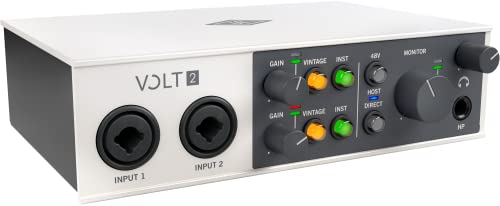
For musicians and audio professionals seeking high-quality recording solutions, the Universal Audio Volt 2 USB Audio Interface stands out with its ability to capture audio at up to 24-bit/192 kHz quality. You’ll enjoy the classic warmth of UA’s 610 preamps, especially with Vintage mode activated for a rich, album-ready sound. Coupled with the award-winning LUNA Digital Audio Workstation, you can record and mix effortlessly. Plus, you’ll have access to industry-trusted UAD plug-ins, enhancing your projects. Its compatibility with various devices, including iPad and iPhone, makes it perfect for both mobile and studio setups, ensuring you’re always ready to create.
Best For: Musicians and audio professionals seeking high-quality recording solutions for both mobile and studio environments.
Pros:
- Exceptional audio quality with 24-bit/192 kHz recording capability.
- Classic UA 610 preamps with Vintage mode for rich, warm sound.
- Compatible with multiple devices including MacOS, Windows, iPad, and iPhone.
Cons:
- Requires an external power supply for operation.
- May need additional adapters for certain devices, such as the Apple Lightning to USB Camera Adapter.
- Some users may find the learning curve steep when using the LUNA Digital Audio Workstation.
Universal Audio Volt 1 USB Audio Interface
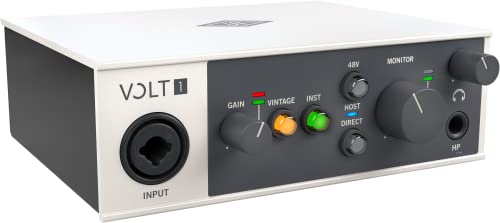
If you’re looking to elevate your home studio setup, the Universal Audio Volt 1 USB Audio Interface stands out with its rich, album-ready sound powered by classic 610 preamps. With Vintage mode, you can capture every detail at up to 24-bit / 192 kHz. Seamlessly record and mix using the award-winning LUNA Digital Audio Workstation, giving you an analog studio feel. You’ll also gain access to trusted UAD plug-ins and tutorials that enhance your skills, whether you’re a beginner or advanced. Plus, it’s compatible with various devices, making it a portable choice for your recording needs.
Best For: The Universal Audio Volt 1 USB Audio Interface is best for musicians and audio engineers seeking high-quality sound production in a compact and versatile format.
Pros:
- Rich sound quality from classic 610 preamps with Vintage mode for an authentic analog feel.
- High resolution audio capture up to 24-bit / 192 kHz for detailed recordings.
- Compatibility with multiple devices including MacOS, Windows, iPad, and iPhone for flexible recording setups.
Cons:
- Requires external power supply, which may limit portability.
- Apple Lightning to USB Camera Adapter needed for certain iOS devices not equipped with USB-C.
- LUNA DAW might have a learning curve for users unfamiliar with digital audio workstations.
Universal Audio Apollo Solo Heritage Edition, APLS-HE

Packed with powerful features, the Universal Audio Apollo Solo Heritage Edition (APLS-HE) is perfect for musicians and producers seeking professional-grade sound in a compact package. This 2×4 Thunderbolt 3 interface boasts two Unison mic preamps and UAD SOLO Core Processing, allowing real-time tracking with vintage compressors and EQs. With five award-winning plug-ins valued at $1,300 included, you’ll have everything needed for studio-quality recordings. It’s bus-powered for portability, and its best-in-class headphone amplifier guarantees detailed monitoring. Compatible with major DAWs and LUNA, the APLS-HE is a stellar choice to elevate your sound quality seamlessly.
Best For: Musicians and producers looking for a compact, professional-grade audio interface with real-time tracking capabilities and premium plug-ins.
Pros:
- High-quality sound: Features vintage compressors and EQs for professional studio recordings.
- Portability: Bus-powered design makes it easy to take on the go, reducing cable clutter.
- Comprehensive software compatibility: Works seamlessly with major DAWs and includes five award-winning plug-ins.
Cons:
- Limited inputs: Only two mic preamps may not be sufficient for larger recording sessions.
- Higher price point: The inclusion of premium plug-ins contributes to a higher cost compared to basic interfaces.
- Thunderbolt 3 requirement: Requires a compatible Thunderbolt 3 connection, which may not be available on all computers.
Universal Audio Apollo Twin X DUO Gen 2 Audio Interface

The Universal Audio Apollo Twin X DUO Gen 2 Audio Interface is an excellent choice for musicians and producers seeking high-quality analog tones and real-time recording capabilities. With dual Unison mic preamps and access to over 200 UAD DSP and Native plug-ins, you can achieve professional sound effortlessly. Its Apollo Monitor Correction guarantees accurate mixing, while the Auto-Gain feature simplifies level settings. Plus, the built-in bass management enhances low-end detail, making your mixes richer. Weighing just 4.05 pounds and compatible with both Windows and macOS, it’s a portable powerhouse. Rated 4.6 stars, it’s a trusted option for serious audio production.
Best For: Musicians and producers looking for high-quality analog recording with professional sound capabilities.
Pros:
- Access to over 200 UAD DSP and Native plug-ins for versatile sound design.
- Real-time recording through renowned brand emulations for authentic audio quality.
- Lightweight and portable design, compatible with both Windows and macOS for on-the-go production.
Cons:
- Higher price point compared to entry-level audio interfaces.
- Requires Thunderbolt 3 connectivity, which may necessitate additional hardware for some users.
- Limited to dual Unison mic preamps, which may not suffice for larger recording setups.
M-AUDIO M-Track Solo USB Audio Interface for Recording and Streaming
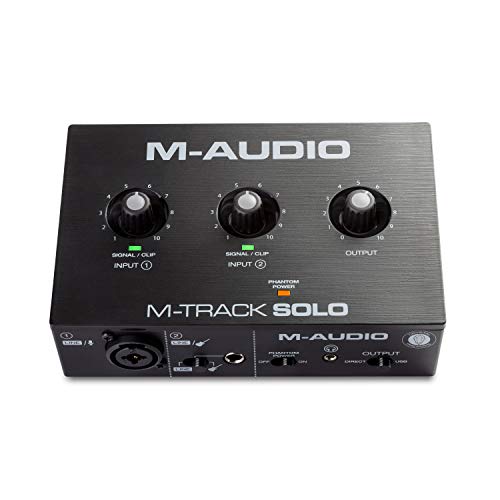
For budding musicians and content creators, the M-AUDIO M-Track Solo USB Audio Interface is an ideal choice for recording and streaming. This interface is compatible with both Mac and PC, delivering 48kHz audio resolution for superior quality. With one combo XLR/Line input and one Line/Instrument input, you can easily record vocals, guitar, and other signals. The transparent Crystal Preamp guarantees excellent sound quality, especially for condenser mics. Plus, the USB/Direct switch allows for zero latency monitoring through the 1/8 headphone output or stereo RCA outputs. It even includes MPC Beats Software, giving you essential production tools right out of the box.
Best For: Budding musicians and content creators looking for a high-quality USB audio interface for recording and streaming.
Pros:
- High-quality 48kHz audio resolution for superior recordings.
- Transparent Crystal Preamp ensures optimal sound quality for all microphones.
- Includes MPC Beats Software for enhanced music production capabilities.
Cons:
- Limited to one XLR/Line input and one Line/Instrument input, which may not suffice for larger setups.
- No MIDI input/output options for connecting MIDI devices.
- Basic monitoring options may not meet the needs of professional audio engineers.
Universal Audio Volt 276 USB Audio Interface

Elevating your recording experience, the Universal Audio Volt 276 USB Audio Interface is ideal for musicians and producers seeking professional-quality sound without the complexity of traditional studio setups. With classic UA 610 preamps and a Vintage mode, you’ll achieve rich, album-ready sound. The built-in analog compressor, inspired by the legendary 1176, adds clarity and punch to your vocals and instruments. Easily integrate with the award-winning LUNA DAW for a real analog studio feel, and access UAD plug-ins used by the pros. Plus, it’s compatible with your Mac, Windows, or iOS devices, making it the perfect portable solution.
Best For: Musicians and producers seeking high-quality audio recording and mixing in a portable format.
Pros:
- Classic UA 610 preamps with Vintage mode provide rich, professional sound quality.
- Built-in analog compressor enhances clarity and punch for vocals and instruments.
- Compatible with multiple devices including Mac, Windows, and iOS for versatile recording options.
Cons:
- Requires external power supply for operation, which may limit portability.
- Additional adapters may be needed for certain iPad models, increasing setup complexity.
- Limited built-in features compared to larger, more complex audio interfaces.
Universal Audio Volt 476p USB Audio Interface
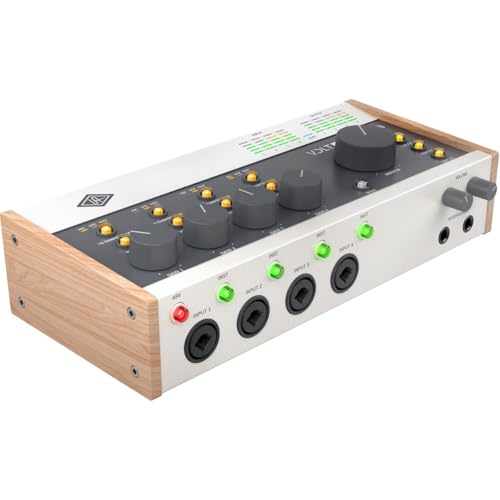
If you’re looking to achieve professional-grade recordings without breaking the bank, the Universal Audio Volt 476p USB Audio Interface is an excellent choice. With its classic UA 610 preamps and Vintage mode, you can enhance your sound quality considerably. The built-in analog compressor, inspired by the iconic 1176, adds clarity and punch to your recordings. You’ll also appreciate the included LUNA Digital Audio Workstation, offering a real analog studio experience. Plus, it’s compatible with MacOS, Windows, and iOS devices. Whether you’re a beginner or advanced user, you’ll find valuable tips and tutorials to elevate your recording game.
Best For: Musicians and audio engineers seeking professional-quality recordings on a budget.
Pros:
- Classic UA 610 preamps with Vintage mode enhance sound quality.
- Built-in analog compressor inspired by the 1176 adds clarity and punch to recordings.
- Includes LUNA Digital Audio Workstation for an authentic analog studio experience.
Cons:
- Requires an external power supply for operation.
- Compatibility limitations for iOS devices without USB-C ports.
- Some users may find the learning curve steep if unfamiliar with audio interfaces.
M-AUDIO M-Track Duo USB Audio Interface for Recording and Streaming

The M-AUDIO M-Track Duo USB Audio Interface stands out as an ideal choice for aspiring musicians and podcasters seeking a compact yet powerful solution. It features two combo XLR/Line/Instrument inputs with phantom power, perfect for recording vocals, guitars, or other line signals. With a 48kHz audio resolution, you’ll enjoy clear sound quality thanks to its transparent Crystal Preamps. Monitoring is a breeze with the 1/4 headphone output and stereo outputs, plus the USB/Direct switch guarantees zero latency. Plus, it comes with MPC Beats Software, giving you essential tools to elevate your music production game.
Best For: Aspiring musicians and podcasters looking for a compact and powerful audio interface for recording and streaming.
Pros:
- Versatile Input Options: Two combo XLR/Line/Instrument inputs with phantom power for various recording needs.
- High-Quality Sound: Transparent Crystal Preamps ensure optimal sound quality for all microphone types.
- Zero Latency Monitoring: USB/Direct switch allows for real-time monitoring without delays.
Cons:
- Limited Audio Resolution: Maximum audio resolution of 48kHz may not meet the needs of professional users seeking higher fidelity.
- Basic Software Bundle: Comes with MPC Beats Software, which may not be sufficient for advanced production needs.
- Portability Concerns: While compact, the interface may lack ruggedness for frequent travel or outdoor use.
Fender AudioBox GO USB Audio Interface for Musicians
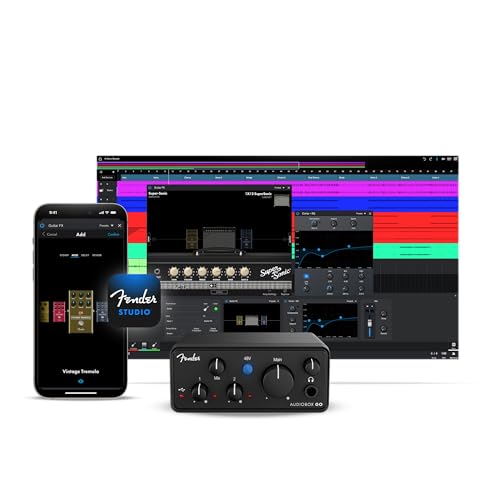
For musicians seeking a portable and powerful solution, the Fender AudioBox GO USB Audio Interface stands out with its ultra-compact design and high-quality 24-bit/96 kHz converters. Designed for guitarists, vocalists, and producers, it features an XLR mic/line combo input with switchable +48V phantom power and a dedicated instrument input optimized for guitar and bass. You’ll enjoy zero-latency headphone monitoring with mix control for real-time tracking. Plus, its bus-powered design guarantees easy plug-and-play operation on both Mac and PC. With the included Fender Studio app, you can access a wealth of authentic amp models and effects to elevate your sound.
Best For: Musicians, including guitarists, vocalists, and producers, seeking a portable and high-quality USB audio interface for recording and mixing.
Pros:
- Ultra-compact design makes it easy to transport and set up anywhere.
- Zero-latency headphone monitoring allows for real-time tracking without delays.
- Comprehensive software package includes access to Fender Studio and authentic amp models.
Cons:
- Limited advanced features in the basic Fender Studio app without the upgrade to Fender Studio Pro.
- Dependent on USB power, which may limit usage in certain environments without a power source.
- No onboard effects processing, requiring reliance on software for sound manipulation.
Factors to Consider When Choosing Audio Interfaces for Recording
When you’re choosing an audio interface for recording, there are several important factors to keep in mind. Think about audio quality standards, input and output options, and how well it works with your software. Portability and preamp quality also play vital roles in ensuring you get the best recording experience possible.
Audio Quality Standards
Choosing the right audio interface can greatly impact your recording quality, especially when you consider key factors like sample rates and bit depth. Look for interfaces that offer sample rates from 44.1 kHz to 192 kHz; higher rates provide greater detail and clarity. Bit depth matters too—aim for 24-bit depth, which allows for a dynamic range of 144 dB, capturing subtle nuances in sound. High-quality preamps can further enhance clarity and warmth, particularly those that emulate classic studio gear. Additionally, check the dynamic range; interfaces with 100 dB or higher are ideal. Features like vintage modes or analog compression can also polish your recordings, giving them the professional, album-ready quality you’re after.
Input and Output Options
Input and output options play an important role in your audio interface selection, impacting how you capture and monitor sound. Consider the number of input options available, like combo XLR/Line inputs, so you can accommodate vocals, instruments, and line signals. Look for interfaces that provide phantom power for condenser microphones, which is essential for high-quality audio. Evaluate output options, including balanced TRS outputs for connecting to studio monitors or powered speakers, ensuring best playback sound quality. Zero-latency monitoring capability is critical for real-time tracking, letting performers hear themselves without delay while recording. Finally, make sure your interface is compatible with various recording software and systems, maximizing its versatility for different production environments.
Software Compatibility
How do you guarantee your audio interface integrates smoothly with your recording setup? First, check its compatibility with major digital audio workstations (DAWs) like Pro Tools, Ableton Live, and Logic Pro. This assures seamless integration and a hassle-free experience. Look for interfaces that come with bundled software packages, as they can enhance your recording capabilities and provide essential tools for mixing and mastering. Additionally, confirm that the interface supports various plug-in formats like VST, AU, and AAX to access a wide range of audio effects and virtual instruments. It’s also vital to verify compatibility with both Windows and macOS systems. Finally, consider interfaces that offer learning resources or tutorials to boost your skills in recording and mixing.
Portability and Connectivity
When setting up your recording gear, portability and connectivity can make all the difference, especially if you’re on the move. Look for bus-powered audio interfaces that simplify transport, eliminating the need for bulky power supplies. Opt for USB-C connectivity for faster data transfer and compatibility with modern devices, enhancing your recording experience. Pay attention to the weight and dimensions; lighter, more compact designs are easier to set up and tear down during gigs. Additionally, confirm your interface works seamlessly with both macOS and Windows, allowing flexibility across different recording environments. Finally, prioritize zero-latency monitoring features, as they’ll help you track in real-time without disruptive delays, keeping your creative flow intact.
Preamp Quality
Preamp quality is essential in determining the clarity and detail of your recordings. High-quality preamps considerably enhance sound quality, offering greater transparency and preserving the natural characteristics of your microphones. Look for transparent preamps in professional audio interfaces to avoid unwanted coloration in your recordings. If you often use low-output microphones, choose preamps with higher gain capabilities to guarantee superior recording levels without introducing noise. Some interfaces even provide vintage modes, adding warmth and character to your sound—perfect for certain music styles. Finally, make certain the preamps include phantom power to support condenser microphones, enabling them to perform at their best during recording sessions. Prioritize preamp quality to elevate your audio experience.
User-Friendly Features
Choosing the right audio interface involves considering various user-friendly features that can streamline your recording process. Look for interfaces with Auto Gain, which automatically adjusts levels for your microphones or instruments, making it easier to get started. Zero-latency monitoring is another essential feature, allowing you to hear your input in real-time without any delays, enhancing your overall experience. Interfaces that come with built-in software bundles, including digital audio workstations and plugins, offer a thorough solution right out of the box. Confirm compatibility with different operating systems and devices for seamless integration. Finally, access to user guidance resources, such as tutorials and online support, can help you maximize your recording quality and workflow efficiency.