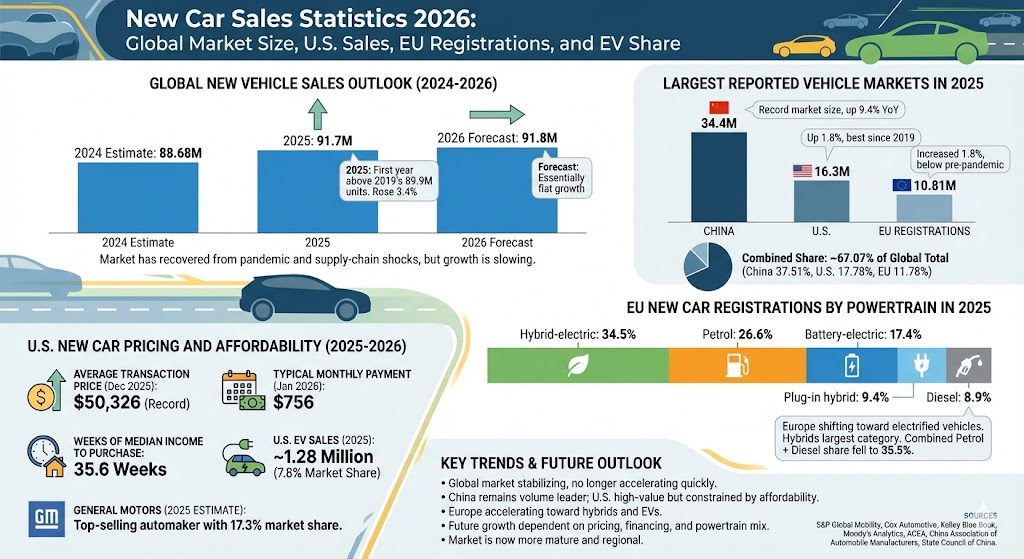
These new car sales statistics show how the market performed heading into 2026, including global new-vehicle volume, U.S. sales, EU new car registrations, China’s record market size, and the latest EV and hybrid mix data.
Most international sources report new-vehicle or light-vehicle sales, while Europe typically reports new passenger-car registrations. Where definitions differ, they are labeled clearly below.
new car sales statistics
New car sales statistics (top highlights)
Global new vehicle sales rose 3.4% in 2025 to about 91.7 million units.
S&P Global Mobility expects global sales to stay nearly flat in 2026 at around 91.8 million units.
According to S&P Global Mobility, 2025 was the first year global new vehicle sales moved above 2019’s 89.9 million units.
China sold 34.4 million vehicles in 2025, up 9.4% year over year and a new record.
U.S. new-vehicle sales reached 16.3 million in 2025, up 1.8% from 2024 and the best result since 2019.
General Motors was expected to finish 2025 as the top-selling automaker in the U.S. with 17.3% market share.
U.S. EV sales in 2025 were about 1.28 million units, equal to 7.8% of the total new-vehicle market.
EU new car registrations increased 1.8% in 2025, although overall volumes remained below pre-pandemic levels.
Battery-electric cars accounted for 17.4% of the EU market in 2025, while hybrid-electric vehicles led with a 34.5% share.
Using ACEA’s published powertrain volumes and shares, total EU new car registrations in 2025 work out to roughly 10.81 million units.
The China, U.S., and EU markets together represented about 67.07% of the 2025 global total.
In the U.S., the average transaction price for a new vehicle reached a record $50,326 in December 2025.
In January 2026, the typical monthly payment for a new vehicle in the U.S. was $756, and buyers needed 35.6 weeks of median income to purchase the average new vehicle.
The market has largely recovered from the pandemic and supply-chain shock years, but growth is slowing. After rebounding in 2025, S&P Global Mobility expects the global market to be essentially flat in 2026.
Largest reported vehicle markets in 2025
Label
Bar
Value
China
34.4M
U.S.
16.3M
EU registrations
10.81M
Max = 34.4M. Widths: China 100.00%, U.S. 47.38%, EU registrations 31.41%
China remained the largest vehicle market by a wide margin in 2025. The U.S. stayed comfortably in second place, while the EU passenger-car market was smaller but still one of the biggest pools of new car demand worldwide.
These three markets alone accounted for about 67.07% of the 2025 global total. China represented 37.51%, the U.S. 17.78%, and the EU about 11.78%.
EU new car registrations by powertrain in 2025
Label
Bar
Value
Hybrid-electric
34.5%
Petrol
26.6%
Battery-electric
17.4%
Plug-in hybrid
9.4%
Diesel
8.9%
Max = 34.5%. Widths: Hybrid-electric 100.00%, Petrol 77.10%, Battery-electric 50.43%, Plug-in hybrid 27.25%, Diesel 25.80%
Europe’s new car market kept shifting toward electrified vehicles in 2025. Hybrids were the largest category, battery-electric vehicles expanded to 17.4% share, and the combined petrol-plus-diesel share fell to 35.5%.
U.S. new car pricing and affordability
Sales improved in the U.S. in 2025, but affordability remained a major constraint. Kelley Blue Book said the average transaction price for a new vehicle reached a record $50,326 in December 2025. In January 2026, Cox Automotive said the typical monthly payment was $756 and the average buyer needed 35.6 weeks of median income to purchase a new vehicle.
That combination helps explain why the U.S. market recovered without returning to earlier cycle peaks. Demand improved, but high prices and financing costs still capped how far the market could rebound.
What these new car sales statistics show
The global auto market entered 2026 on much firmer footing than it had during the supply-constrained years, but momentum is no longer accelerating quickly. Global sales are now back above 2019 levels, yet the forecast for 2026 points to a market that is stabilizing rather than booming.
China remains the clear volume leader, the U.S. continues to be a high-value but affordability-constrained market, and Europe is moving faster toward hybrids and EVs even while overall car registrations stay below pre-pandemic norms. In other words, new car sales are growing again, but the next phase looks more mature, more regional, and more dependent on pricing, financing, and powertrain mix than on simple unit recovery alone.
Sources
S&P Global Mobility, Five projections for the 2026 automotive industry outlook, January 30, 2026.
Cox Automotive, December 2025 U.S. auto sales forecast, updated January 7, 2026.
Cox Automotive and Kelley Blue Book, Q4 2025 EV sales report, January 13, 2026.
Kelley Blue Book average transaction price report, January 12, 2026.
Cox Automotive and Moody’s Analytics Vehicle Affordability Index, January 2026 update, published March 16, 2026.
ACEA, New car registrations: +1.8% in 2025; battery-electric 17.4% market share, January 27, 2026.
China Association of Automobile Manufacturers data summarized by the State Council of China, January 14, 2026.